Wix vs WordPress vs Squarespace for Small Business: What 411 Shropshire Websites Show

Wix or Squarespace suits a small business that wants to build and run a simple website itself, with hosting and the technical basics handled for it. WordPress suits a business that wants full control, room to grow and the freedom to change host, and usually has a designer or developer to set it up. When we checked 411 Shropshire business websites in November 2026, the Wix and Squarespace sites got more technical defaults right, while WordPress sites varied with whoever built them. On every platform, naming the town was left to the owner.
A note before you read on: Digiwings designs and builds bespoke WordPress websites, so we are not neutral. We have kept facts, our data and our opinion apart, taken prices and features only from the platforms' own pages, and included a section on when Wix or Squarespace is the better choice.
In short
- What Shropshire uses: of 411 business websites, 190 (46%) run on WordPress, 43 (10%) on Wix, 23 (6%) on Squarespace and 14 (3%) on GoDaddy.
- Builders handle the defaults: local business markup was on 74% of Squarespace and 49% of Wix sites, against 14% of WordPress sites.
- Your town is up to you: only 3 of 23 Squarespace home-page titles named the town or Shropshire.
- Prices on 10 November 2026: from £9 + VAT a month on Wix, £14.40 a month including VAT on Squarespace and £3 + VAT a month on WordPress.com, each billed yearly.
- Leaving: a Wix site cannot run on another host, Squarespace exports only some content, and a WordPress site can move whole.
Which is best for a small business: Wix, WordPress or Squarespace?
None of them is best for every business; the right one depends on who will build the site, who will look after it and how much it has to do.
| Wix | Squarespace | WordPress | |
|---|---|---|---|
| What it is | Hosted website builder | Hosted website builder | Open-source software, self-hosted (WordPress.org) or hosted (WordPress.com) |
| Hosting and upkeep | Included | Included | Included on WordPress.com; on a self-hosted site, your job or your web company's |
| Free option | Free plan, with Wix branding and no own domain | 14-day free trial, no free plan | WordPress.com free plan; the WordPress.org software is free |
| Cheapest paid plan, 10 Nov 2026 | £9 + VAT a month, billed yearly | £14.40 a month including VAT, billed yearly | WordPress.com: £3 + VAT a month, billed yearly |
| Moving away | The site cannot run on another host | Some content exports as a WordPress file | The whole site can move to another host |
| Local business markup in our data | 21 of 43 sites (49%) | 17 of 23 sites (74%) | 26 of 190 sites (14%) |
Our view: a sole trader who wants a tidy five-page site and will update it themselves is usually well served by Wix or Squarespace. A business whose website brings in most of its enquiries, and which will keep adding pages, gets more room from WordPress, if someone sets it up and maintains it properly.
What do Shropshire businesses build on?
In our sample, WordPress is by far the most common platform. We took 411 independent businesses in eight sectors across Shrewsbury, Telford, Oswestry, Bridgnorth, Ludlow, Market Drayton and Whitchurch, all found through Google Maps. On 10 November 2026 our script identified each website's platform from the code its home page sends.
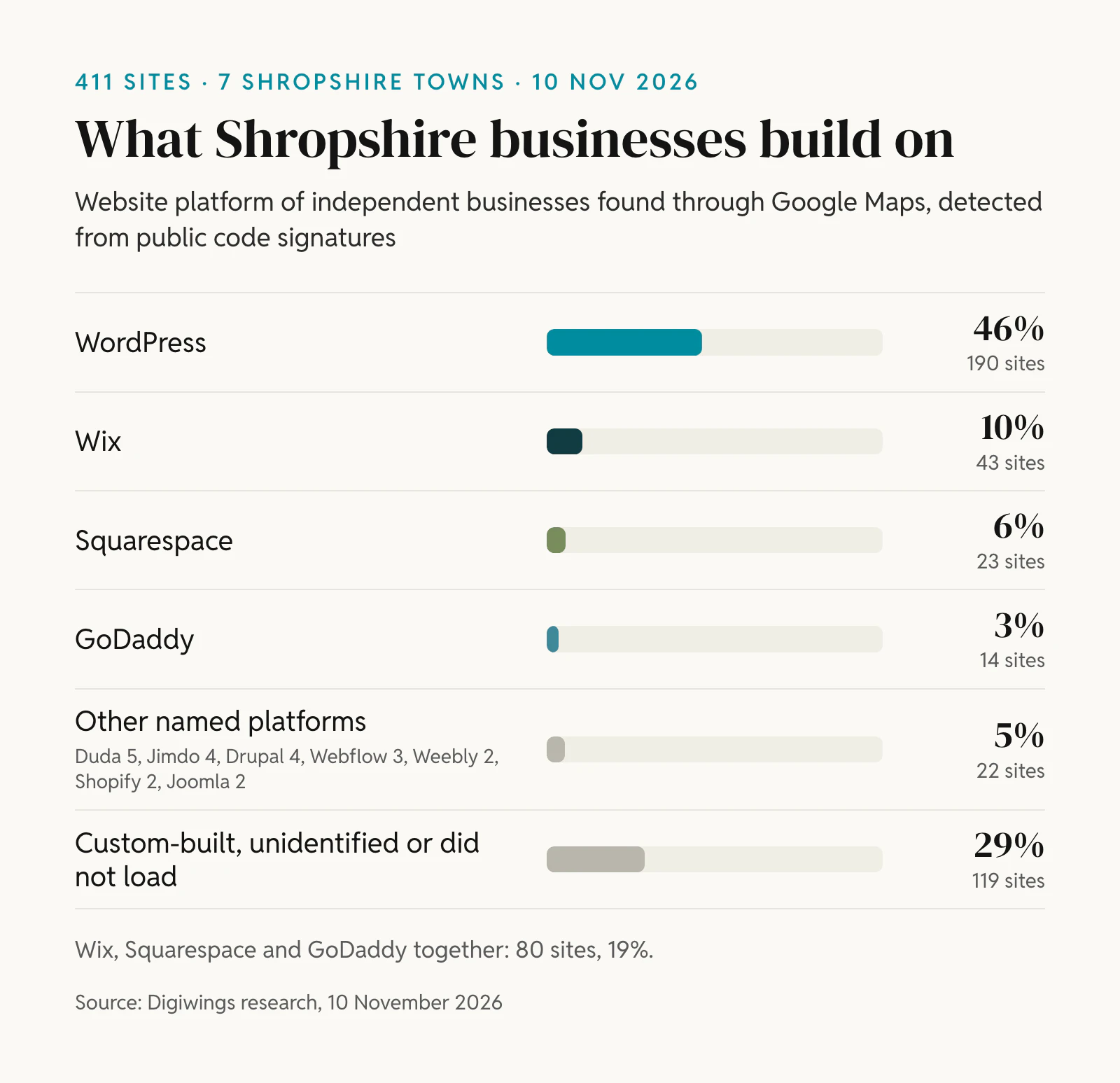
Wix, Squarespace and GoDaddy's builder together account for 80 sites (19%). The last group of 119 was custom-built, used a platform our script could not identify, or did not load.
How do the platforms compare on local search basics?
The website builders got the technical defaults right more often, WordPress sites were mixed, and naming the town was patchy everywhere. These are the basics that help search engines and AI assistants understand a local business.
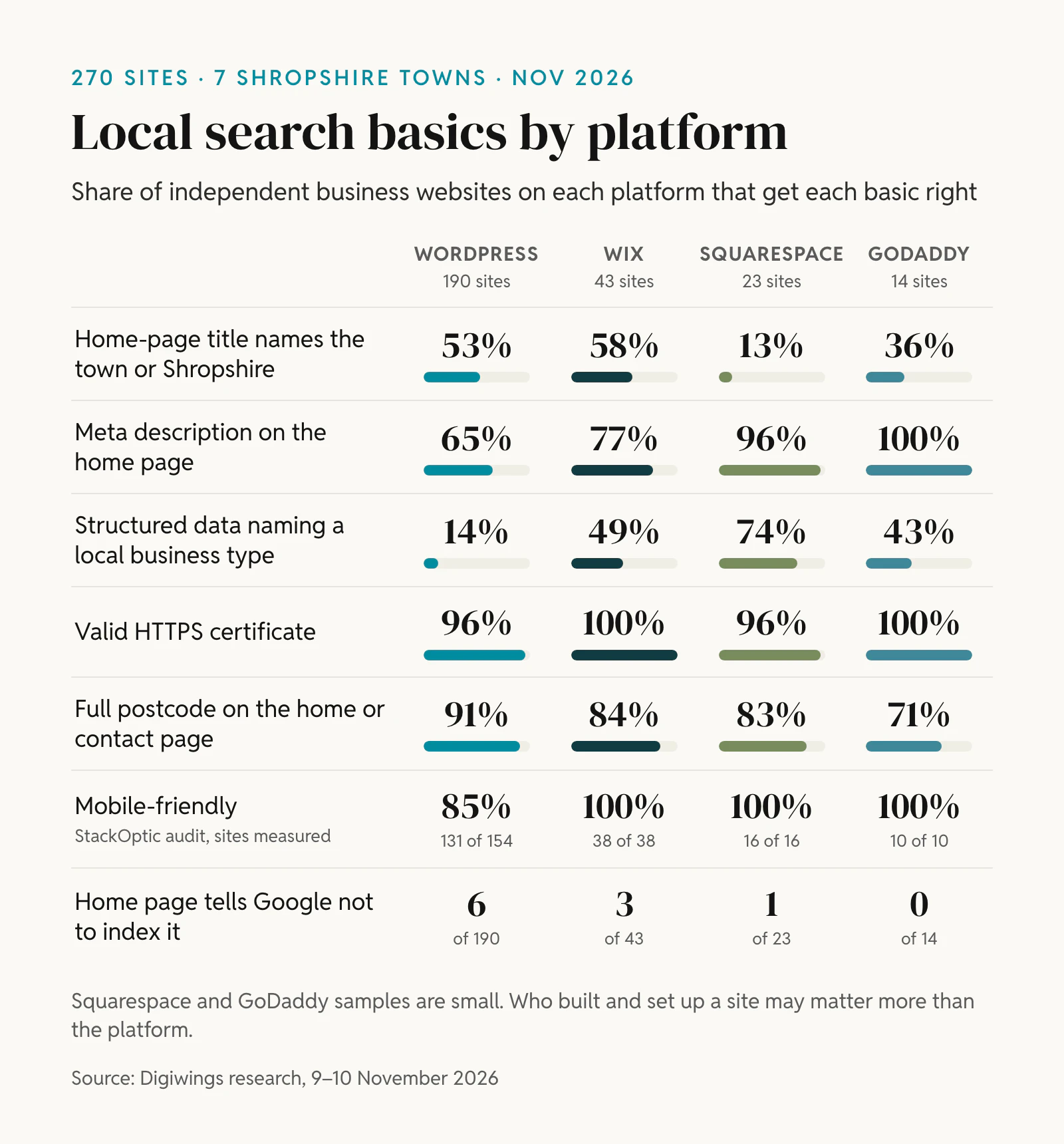
- Descriptions and markup: all 14 GoDaddy sites and 22 of 23 Squarespace sites had a meta description, against 65% of WordPress sites. Local business markup, which tells machines what kind of business you are and where, was on 74% of Squarespace sites and 14% of WordPress sites.
- Mobile: StackOptic, our own audit tool, measured a subset. All 64 builder sites it measured passed its mobile-friendly test, against 131 of 154 WordPress sites (85%).
- Postcode: WordPress sites led, with 91% showing a full postcode on the home or contact page.
- Town in the title: Wix 58%, WordPress 53%, GoDaddy 36% and Squarespace 13%.
- Hidden from Google: six WordPress home pages, three Wix and one Squarespace told Google not to index them. All six WordPress pages carried the tag WordPress adds when "Discourage search engines" is ticked. Our guide to why a business is not showing on Google shows how to check.
Read these as patterns, not verdicts. The Squarespace and GoDaddy samples are small: one Squarespace site is about four percentage points. The data shows what each site has, not why, and not how it ranks. Our interpretation, which we did not measure: who built a site, and how carefully, matters more than the platform.
Is Wix or WordPress better for SEO?
Neither platform ranks a site on its own; the difference is how much each does for you by default. The platforms' own help pages explain most of the gaps in our data:
- Wix says that once you add a business name and location to your account, it automatically creates Local Business markup for your home page. About half the Wix sites in our sample had it, which fits that rule: the markup depends on whether the owner has added those details.
- Squarespace says it automatically generates structured data, including local business markup, plus meta tags, and that all its sites are mobile-optimised by default. But its default home-page title is just the site title, which would account for so few naming the town. You can change the format.
- WordPress leaves more to whoever builds the site. Its SEO documentation says meta tags are not included by default, so descriptions come from the theme, an SEO plugin or the developer. In our experience, local business markup does too.
Our view: WordPress gives more control as a site grows; the builders give you fewer ways to get the basics wrong. Either way, what moves you up is the same: a page for each service, the towns you cover named in plain text, a complete Google Business Profile and genuine reviews.
What about AI answers and llms.txt?
An llms.txt file is a summary of a site written for AI tools. In our sample, 87 of 411 sites (21%) had one, mostly on builders: 40 of the 43 Wix sites and 12 of the 14 GoDaddy sites, against 20 of 190 WordPress sites and no Squarespace sites. Wix says it generates and maintains the file automatically. We could not find a GoDaddy page that explains its files.
Do not choose a platform for this. Google's guidance on AI features in Search says: "You don't need to create new machine readable files, AI text files, or markup to appear in these features." Our study of 112 ChatGPT and Gemini answers shows what AI assistants actually used in Shropshire.
How much do Wix, Squarespace and WordPress cost in the UK?
On 10 November 2026 the cheapest paid plans were £9 + VAT a month on Wix, £14.40 a month including VAT on Squarespace and £3 + VAT a month on WordPress.com, each billed yearly. These are the prices each pricing page showed a UK visitor that day.
| Platform | Cheapest paid plan | Plan the platform highlights | How prices are shown |
|---|---|---|---|
| Wix | Light: £9 a month | Business ("recommended"): £25 a month | Yearly plans paid upfront, excluding VAT |
| Squarespace | Basic: £14.40 a month yearly, or £19.20 monthly | Core ("recommended"): £20.40 a month yearly, or £28.80 monthly | Including estimated VAT |
| WordPress.com | Personal: £3 a month yearly, or £8 monthly | Premium ("most popular"): £7 a month yearly, or £17 monthly | Excluding taxes |
| Self-hosted WordPress | The software is free. You pay for hosting, a domain, any paid themes or plugins, the build and upkeep | Varies by provider | |
- Wix offers a 14-day money-back guarantee on a first upgrade.
- Squarespace starts every site with a 14-day free trial, with no card needed.
- WordPress.com is a hosted WordPress service. Its pricing page says plugins can be installed on every paid plan.
Self-hosted WordPress is open-source software under the GPL licence, so the software costs nothing. For context, our own packages start at £695 for a single-page site with the first year's hosting included, and hosting after that starts at £15 a month. Our free website cost calculator gives an itemised estimate.
Our view: compare the cost over three years and count your own time. A builder plan is cheap in cash but costs you hours.
Can you move your website later?
You can with WordPress, partly with Squarespace, and not with Wix, where leaving means rebuilding.
- Wix says your site "needs to be hosted and operated on Wix's servers". Your content belongs to you and you can connect a domain bought elsewhere, but the site cannot run on another host.
- Squarespace lets you export certain content to a WordPress-format file: layout pages, one blog with its posts, and text and image blocks. Store pages, product blocks, style settings and custom CSS do not export.
- WordPress.com exports your posts, pages and comments to a file another WordPress site can import, and the new site copies your images across.
- Self-hosted WordPress can be moved to a new server, files and database together, without reinstalling.
Whatever you choose, register the domain in your business's name and keep the login yourself. If you move, redirect every old page address to its new one. Our free website migration checklist covers each step.
When is Wix or Squarespace the better choice?
A website builder is the better choice when you want a simple site you can build, update and pay for yourself, with nothing to maintain. In our view, that fits many small businesses:
- you are starting out or testing an idea, and need something presentable this month;
- the site is small: a few pages, contact details, a gallery, a menu or simple bookings;
- you want to make changes yourself, without calling anyone;
- nobody will look after software updates, which a self-hosted WordPress site needs.
If you go this way, close the gaps we found: put your service and town in the home-page title, add your business name and address in the platform's business settings, check that search engine indexing is on, and give each main service its own page. A restaurant also needs its menu, hours and booking link to match its Google listing; our guide to getting a restaurant on Google covers that.
When is WordPress the better choice?
WordPress is the better choice when your website is a main source of work and you want to own all of it. In our view, that usually means:
- you plan to grow the site with many service pages, town pages or articles;
- you want to change host, designer or agency without starting again;
- you need features beyond a builder's menu, such as custom listings, memberships or a large shop;
- you have a budget for a professional build and for someone to keep it updated.
The flip side is in our data: of the four platforms, WordPress sites were the most likely to lack a meta description or local business markup. The platform gives you control; it does not do the set-up for you.
Is Wix or GoDaddy better for a small business?
Our data cannot settle it, because we found only 14 GoDaddy sites against 43 on Wix. Every GoDaddy site had a meta description and a valid HTTPS certificate, but only 5 of 14 named the town in the home-page title, against 58% of Wix sites.
GoDaddy's website blocked our automated check, so we could not confirm its current UK prices; compare them on its own site. Our view: whichever builder you pick, make sure you can edit the home-page title and description, add your address and export your content.
How can Digiwings help?
We build bespoke WordPress websites and run local SEO for Shropshire businesses from our studio in Shrewsbury. If your Wix, Squarespace or GoDaddy site works for you, we will not tell you to move. Send us your website and we will check it against the basics in this article, free of charge, and tell you what to change on the platform you have. If you are starting out or have outgrown a builder, see our web design packages and our pages for Shrewsbury, Telford and Ludlow, or try the free SEO and AI readiness check.
Frequently asked questions
Is Wix good for a small business?
Yes, for a small site the owner builds and updates. On 10 November 2026 its paid plans started at £9 + VAT a month, billed yearly, with hosting included. The biggest catch, in our view, is that a Wix site cannot be moved to another host.
Is Wix or Squarespace better for a small business?
They are close. Wix has a free plan and a cheaper entry plan; Squarespace has a 14-day free trial and its prices include VAT. In our data, Squarespace sites more often had local business markup, but only 3 of 23 named their town in the home-page title. Try both editors and pick the one you find easier.
Is WordPress better than Wix for SEO?
Not automatically. WordPress gives more control but leaves meta descriptions and markup to the theme, plugins or developer, while Wix does more by default. In our Shropshire data, 14% of WordPress sites had local business markup against 49% of Wix sites, which suggests the set-up matters more than the platform.
Is WordPress free?
The WordPress software is free and open source. You still pay for hosting, a domain, any paid themes or plugins and the build. WordPress.com is a separate hosted service with a free plan and paid plans from £3 + VAT a month, billed yearly, as of 10 November 2026.
Can I move my Wix site to WordPress?
Not as it stands. Wix says its sites must be hosted on Wix's servers, so moving means rebuilding the site on WordPress and copying the content across. Keep your domain and redirect every old page address to its new one.
Is Wix or GoDaddy better for a small business?
Our sample is too small to say: 14 GoDaddy sites against 43 on Wix. Every GoDaddy site had a meta description, but only 5 of 14 named the town in the home-page title, against 58% of Wix sites. Compare current prices on each platform's own site.
How we checked
The 411 businesses are the sample from our ChatGPT study: independent plumbers, electricians, accountants, solicitors, dentists, hairdressers, estate agents and restaurants whose Google Maps listing named one of the seven towns as the postal town and linked to a website. On 9 November 2026 our crawler read each home page, contact page and robots.txt file. On 10 November a second script recorded each site's platform from public code signatures and any noindex rule. StackOptic measured mobile-friendliness for 334 of the 411 sites.
Platform detection can miss some sites. We publish totals only, never business names; they are in our platform comparison data (CSV, CC BY 4.0). Prices come from each platform's own pricing page on 10 November 2026, read as a UK visitor sees them.
Sources
Our own data was collected on 9 and 10 November 2026. Platform and Google pages were checked on 10 November 2026; prices and offers change, so check them again before you buy.
- Digiwings, Website platforms and local search basics, November 2026 (CSV, CC BY 4.0), Indexing check of 411 Shropshire business websites and Local search readiness, November 2026.
- Wix, Plans and pricing.
- Wix Help Center, Exporting or Embedding Your Wix Site Elsewhere, Creating Local Business Markup for Your Site's Homepage and Understanding Your Site's llms.txt File.
- Squarespace, Pricing.
- Squarespace Help Center, Export your site content, last updated 9 October 2026.
- Squarespace Help Center, How does Squarespace optimize my site for search results?, last updated 14 July 2026.
- Squarespace Help Center, Change how page titles appear in search engines, browser tabs, and social shares, last updated 8 October 2026.
- WordPress.com, Pricing, and WordPress.com Support, Export your content.
- WordPress.org, About WordPress and GNU Public License.
- WordPress.org Documentation, Search Engine Optimization, last updated 12 May 2026.
- WordPress Developer Resources, Migrating WordPress, last updated 14 October 2026.
- Google Search Central, AI features and your website, last updated 10 December 2025.
Illustration and charts: Digiwings.