How to Get Your Business Recommended by ChatGPT: What 112 AI Answers Showed in Shropshire
No form or payment gets a business into ChatGPT's local recommendations. In our test, the businesses that ChatGPT and Gemini recommended were the ones described clearly and consistently in several places: their own website, their Google Business Profile, and the directories and review sites the assistants already rely on. For most trades, the website was the weakest of those.
On 9 November 2026 we asked both assistants the same eight everyday questions about seven Shropshire towns, 112 answers in all. We also checked the 411 independent business websites that local Google Maps listings link to. This article sets out what we found and what a Shropshire business can do about it.
In short
- Own websites were a minority source: of 435 business recommendations, 130 (30%) cited the business's own website.
- The trade matters most: 80% for solicitors, 46% for accountants and 8% for plumbers, where Checkatrade appeared in 10 of the 14 answers.
- Ratings travel with your name: ChatGPT showed star ratings in 38 of its 56 answers.
- Websites miss the local basics: 94% are secure, but only 53% name their town or county in the home-page title and 24% describe themselves as a local business in structured data.
- Crawlers are rarely the problem: 3 of the 411 sites blocked an AI search crawler.
How did we test this?
We used ChatGPT and Gemini in a signed-out browser on a UK connection on 9 November 2026. Each assistant answered each question once for Shrewsbury, Telford, Oswestry, Bridgnorth, Ludlow, Market Drayton and Whitchurch. The questions were the kind customers ask: a plumber, an electrician, an accountant for a small business, a family solicitor, an NHS dentist taking new patients, a hairdresser, an estate agent for selling a house and somewhere to eat that evening.
For every answer we counted the businesses named, and whether the assistant cited the business's own website, a directory or review platform, or no source. We did not test Perplexity, which needed an account, or Google's AI Mode, which showed a CAPTCHA. We do not bypass CAPTCHAs.
For the website check, we searched Google Maps for the same eight sectors in each town and kept businesses whose listing gave that town as the postal town. We removed national chains and links that were not a business's own site, then examined the 411 independent websites that remained. Our crawler read each home page, contact page and robots.txt file. StackOptic, our own audit tool, measured canonical and Open Graph tags.
Treat the results as a dated snapshot. AI answers change from one run to the next. The Shrewsbury and Telford questions were asked in the early evening and the others late at night. Samples of 35 to 98 sites per town are small. We publish totals only and name no business. The totals are in a downloadable CSV file (CC BY 4.0), and each town's results have their own page, linked at the end of this article.
Does ChatGPT recommend local businesses?
Yes. Across the 112 answers, ChatGPT and Gemini made 435 business recommendations, about four per answer. A business named in two answers counts twice.
The interesting part is where the information came from. Only 130 of the 435 recommendations, 30%, cited the business's own website. The rest relied on listing data, directories, booking platforms and review sites, or gave no source. Gemini cited own websites more often than ChatGPT: 35% of its recommendations, against 24%.
Our reading: an established business usually gets named. What is harder is being described in your own words, and that is the part you control.
Which businesses get cited from their own website?
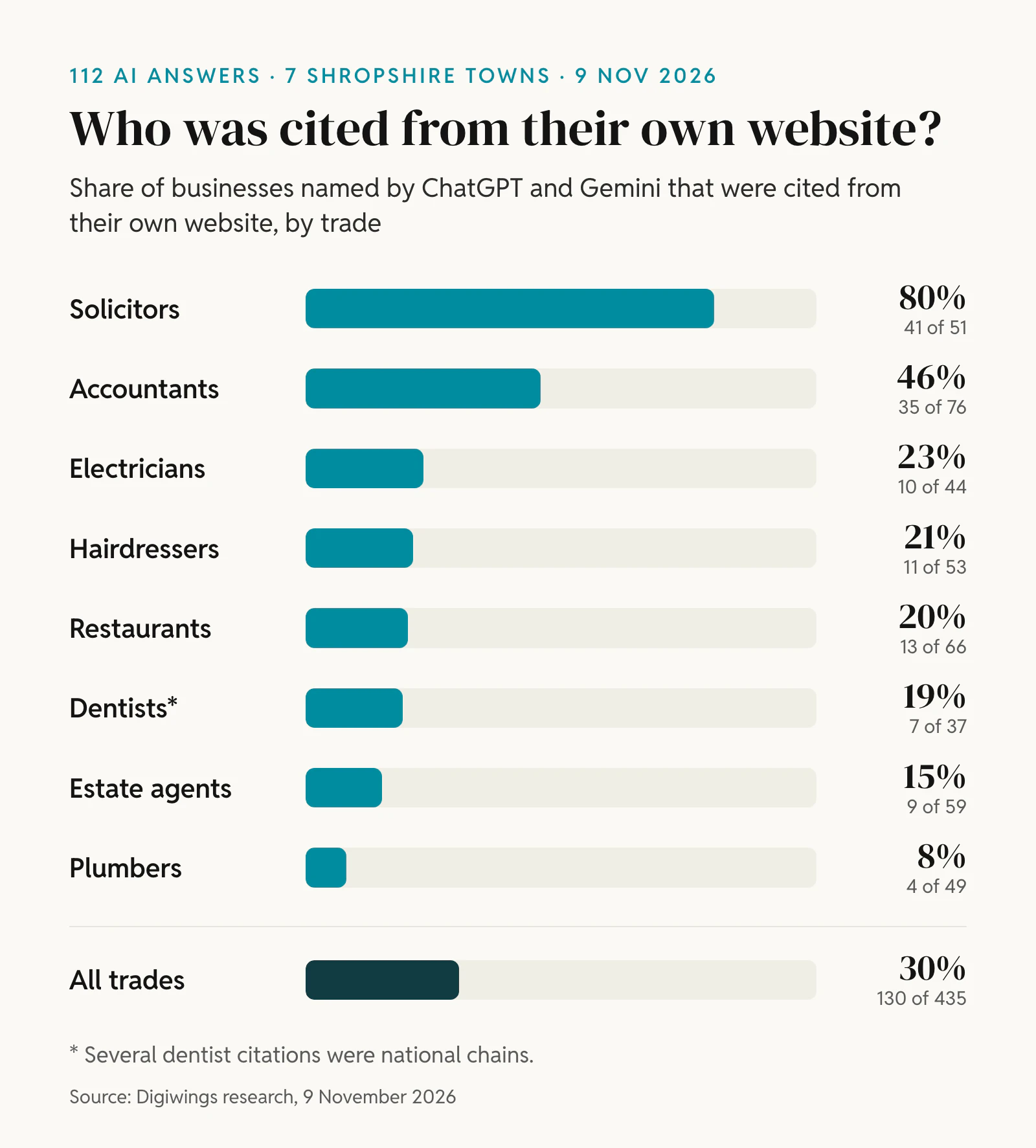
The trade made the biggest difference. Solicitors were cited from their own websites for 41 of their 51 recommendations, 80%. Accountants followed at 46%. Plumbers came last: 4 of 49, or 8%.
Our interpretation: law firms and accountancy practices usually publish a page for each service, say who it is for and often explain fees. That gives an assistant something specific to quote. For plumbers, the assistants turned instead to platforms that hold reviews, job types and the areas a tradesperson covers.
Two notes on the figures. Several of the own-website citations for dentists belonged to national chains rather than independent practices. The restaurant answers were also affected by the time of day, which we come to below.
Which directories and review sites do AI assistants use in Shropshire?
Sixty-seven of the 112 answers drew on at least one directory, booking or review platform. These appeared most often:
- Checkatrade: 11 answers, including 10 of the 14 answers about plumbers;
- Yell: 8 answers, covering plumbers, electricians, accountants and solicitors;
- MyBuilder: 7 answers, for plumbers and electricians;
- GetAgent: 6 of the 14 estate agent answers;
- SalonSpy: 6 of the 14 hairdresser answers, with Fresha and Booksy also appearing;
- NHS pages, dental directories and availability trackers: 13 of the 14 dentist answers.
Local guides mattered too. In Ludlow, ChatGPT linked to The Ludlow Website, a commercial town guide, for accountants and electricians. In Market Drayton, Gemini used a local town guide for restaurants and hairdressers.
What to do: ask the questions your customers ask, note which platforms the answers cite for your trade, and make sure your listing on each one is complete and matches your website. You do not need every directory, only the ones that keep appearing.
Does ChatGPT use Google reviews?
We cannot see where ChatGPT's ratings come from. What we saw was this: ChatGPT showed star ratings and review counts beside the businesses in 38 of its 56 answers. In at least two answers, for estate agents in Shrewsbury and hairdressers in Ludlow, it described them as Google ratings.
The practical conclusion is the same either way. Your rating follows your name into AI answers, not only into Google Maps. Ask satisfied customers for a review and reply to the reviews you get. Never buy or script them: fake reviews and concealed incentives have been unlawful in the UK since April 2025, as the Competition and Markets Authority's fake reviews guidance explains.
What do Shropshire business websites tell search engines and AI?
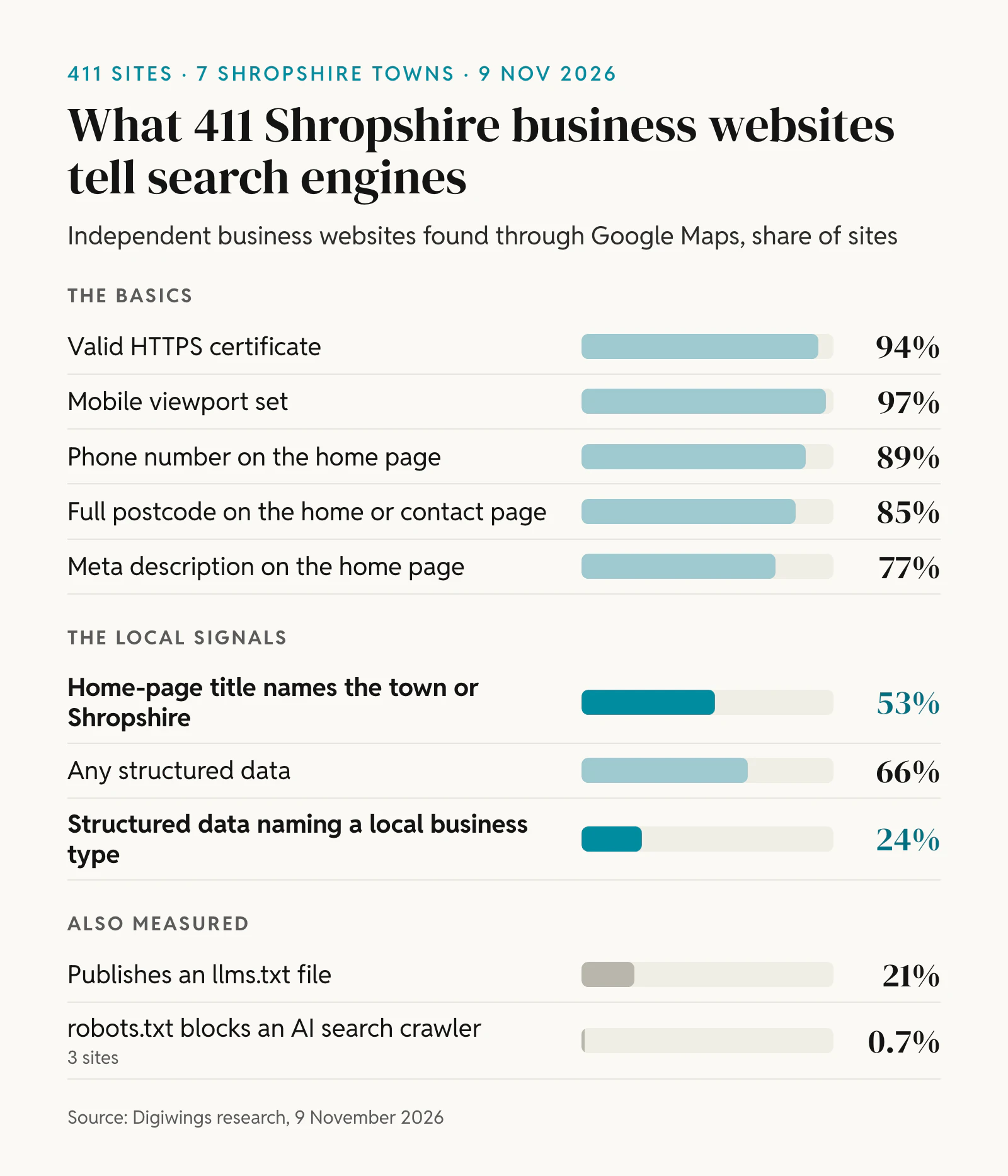
The technical basics are mostly in place. Of the 411 sites, 94% had a valid HTTPS certificate and 97% set a mobile viewport. Contact details were usually there too: 89% showed a phone number on the home page and 85% gave a full postcode on the home or contact page.
Sites fall short on local signals:
- only 53% named their town or Shropshire in the home-page title, ranging from 35% in Market Drayton to 68% in Shrewsbury;
- 66% had some structured data, but only 24% described themselves as a local business type, such as a plumber, dentist or legal service. That is where an address, opening hours and service area can be stated for machines to read;
- 23% had no meta description on the home page.
One comparison sums it up. Almost as many sites published an llms.txt file (21%), which Google says is not needed for Search, as described themselves as a local business in structured data (24%). The new file gets attention while the long-established basics are skipped.
Is blocking AI crawlers stopping you from appearing?
Almost certainly not. Only 3 of the 411 sites blocked an AI search crawler in robots.txt, and 9 blocked a crawler used to train AI models. If your business is missing from AI answers, a blocked crawler is rarely the reason.
If you do decide to block, do it deliberately. OpenAI documents its search crawler, OAI-SearchBot, and its training crawler, GPTBot, as separate controls. Blocking GPTBot does not remove you from ChatGPT's search answers. Blocking OAI-SearchBot can.
When does AI confuse your town with another?
Place names cause more trouble than most owners expect, and Whitchurch was the clearest case. ChatGPT never simply assumed we meant the Shropshire town. Across eight questions it asked which Whitchurch we meant, hedged or answered for another one, and six of its eight answers named no Shropshire business at all. Asked for estate agents, it listed agents in Whitchurch-on-Thames, Hampshire and Cardiff. Gemini assumed Shropshire in five of its eight answers.
Other towns had smaller slips. Asked for a plumber in Shrewsbury, Gemini also offered firms in Shrewsbury, Massachusetts. In Telford, the two assistants gave different addresses for the same firm.
The fix is simple. Put the county and postcode in your page titles, contact details and structured data, and make sure every listing carries the same address.
Do opening hours change what AI recommends?
For ChatGPT, yes. When we asked late in the evening where to eat in Oswestry, Bridgnorth, Ludlow and Market Drayton, ChatGPT recommended only places its listing data showed as open. In Ludlow, at about 11.40pm, it told us most kitchens had closed and offered two places that were still open.
We only saw this with restaurants, but the lesson applies to any business people choose on the spot. Accurate hours on your Google Business Profile, including special hours for bank holidays and closures, decide whether you appear in the answer at that moment.
How to get your business recommended by ChatGPT: a checklist
Based on what we saw, in order of priority:
- Answer the obvious questions on your own website. Say what you do, for whom, where, roughly what it costs and how to book, in plain text rather than images or PDFs. A page for each main service helps.
- Name the town and county in your page titles. "Plumber in Ludlow, Shropshire" tells search engines and assistants far more than "Home".
- Keep your Google Business Profile complete and current. Check the categories, opening hours, special hours and photos, and write a description that matches your site.
- Use the same name, address and phone number everywhere. That means your website, your profile and every directory listing.
- Complete the platforms that appear for your trade. Ask the assistants yourself and fix the listings they cite, whether that is Checkatrade, Yell, a booking platform or a local guide.
- Add local business structured data that matches what the page shows: business type, address, phone number, opening hours and areas served.
- Collect genuine reviews and reply to them. Never buy or script them.
- Leave AI search crawlers alone unless you have a reason to block them. Blocking training crawlers is a separate decision.
- Do not prioritise llms.txt. It does no harm, but Google says it is not needed for Search.
- Check every month. Ask the same questions in a signed-out browser, save the answers with the date and see whether anything changes.
Should you still focus on Google?
Yes. Google says its AI Overviews and AI Mode rely on the same foundations as its ordinary search results and need no special markup or files. The checklist above therefore serves both.
Google also still sends far more visitors. In an analysis of 100 websites over 12 months, published by Marie Haynes on 21 October 2026, visits from ChatGPT equalled 0.62% of the visits from Google's organic results. ChatGPT visitors converted at a higher rate. Even so, among the 55 sites that tracked conversions, Google still drove 96.5% of conversions across the channels analysed.
Our view: treat AI visibility as a result of good local search work, not a replacement for it. In our test, the businesses that the assistants described from their own websites were the ones with clear, specific pages. Those pages also tend to do well on Google.
What we found in each Shropshire town
Each town has its own page with the full results, the questions we asked and the method:
- SEO in Shrewsbury: the best title results, with 68% naming the town or county, but only 22% of sites use local business markup.
- SEO in Telford: the assistants organised answers by centre and business park, and gave two different addresses for one firm.
- SEO in Oswestry: 15% of sites use local business markup, the lowest of the seven towns, and ChatGPT cited the own websites of 5 of the 7 accountants it named.
- SEO in Bridgnorth: the highest own-website rate in AI answers, 39%, although 6 of the 41 sites lacked a valid HTTPS certificate.
- SEO in Ludlow: 14 of 16 answers drew on a directory or platform, more than in any other town.
- SEO in Market Drayton: only 35% of home-page titles name the town, the lowest share.
- SEO in Whitchurch: ChatGPT never simply assumed the Shropshire town.
How can Digiwings help?
We are a Shrewsbury studio, and this kind of check is where our local SEO work starts. If you would like to know what ChatGPT, Gemini and Google show for your business, send us your website and we will run the same checks on it, free of charge. You can also try our free SEO and AI readiness check, or read about our SEO and GEO retainers.
Frequently asked questions
How do I get my business on ChatGPT?
ChatGPT builds local answers from sources it can find: your website, map listings, directories and reviews. Make your website state what you do, where and for whom, keep your Google Business Profile and directory listings consistent with it, and collect genuine reviews. In our Shropshire test, businesses with clear service pages were the most likely to be cited from their own websites.
Why is my business not showing up on ChatGPT?
The patterns we saw were websites that did not say clearly what the business does and where, details that differed between sources, a town name shared with other places and listed hours that showed the business as closed. Blocking OpenAI's search crawler can also keep you out, but only 3 of the 411 Shropshire sites we checked did that. Answers also vary from one run to the next.
Does ChatGPT use Google reviews?
We cannot see where ChatGPT gets its ratings. In our test it showed star ratings in 38 of its 56 answers and described them as Google ratings at least twice. Either way, your reviews follow your name into AI answers.
Do I need an llms.txt file?
Not for Google, which says the file is not needed for Search. 21% of the Shropshire sites we checked have one, almost as many as use local business structured data (24%). Fix your titles, contact details and structured data first.
Should I block GPTBot?
That is a decision about AI training, not search. Blocking GPTBot does not remove you from ChatGPT's search answers, while blocking OAI-SearchBot can. In our check, 9 of the 411 Shropshire sites blocked a training crawler and 3 blocked an AI search crawler.
How often should I check what AI says about my business?
Monthly is enough for most local businesses. Ask the same questions in a signed-out browser, note the date and the sources cited, and look for patterns rather than single answers, which change from run to run.
Sources
Our own data was collected on 9 November 2026. External sources were checked on 10 November 2026.
- Digiwings, Local search readiness, November 2026 (CSV, CC BY 4.0), and the seven town pages linked above.
- Google Search Central, AI features and your website.
- Google Search Central, Latest documentation updates (entry of 15 June 2026 on llms.txt).
- Google Business Profile Help, How to set special hours.
- OpenAI, Overview of OpenAI crawlers.
- Competition and Markets Authority, Fake reviews guidance (CMA208), 4 April 2025.
- Marie Haynes, GEO is a distraction, 21 October 2026.
- Britprint.com Ltd, The Ludlow Website.
Illustration and charts: Digiwings.