How to Rank Higher on Google Maps: What 39 Shropshire Searches Show
To rank higher on Google Maps, make your Business Profile the most relevant and most trusted answer for the search: verify it, choose the right primary category, fill in every detail, collect a steady flow of genuine reviews and link it to a website that says clearly what you do and where. Google says local results depend mainly on relevance, distance and how well known a business is, and that you cannot pay for a better position. Distance you cannot change; the other two you can.
To see what that looks like in practice, we looked at 702 positions in 39 Google Maps searches across eight types of business and seven Shropshire towns on 9 November 2026. In most searches, the businesses in the top three had more reviews, better ratings and a linked website more often than the rest. But the business with the most reviews came first in only 8 of the 39 searches, so reviews are not the whole story.
In short
- How Google ranks local results: relevance, distance and prominence, which Google now also calls popularity. Paying is not an option.
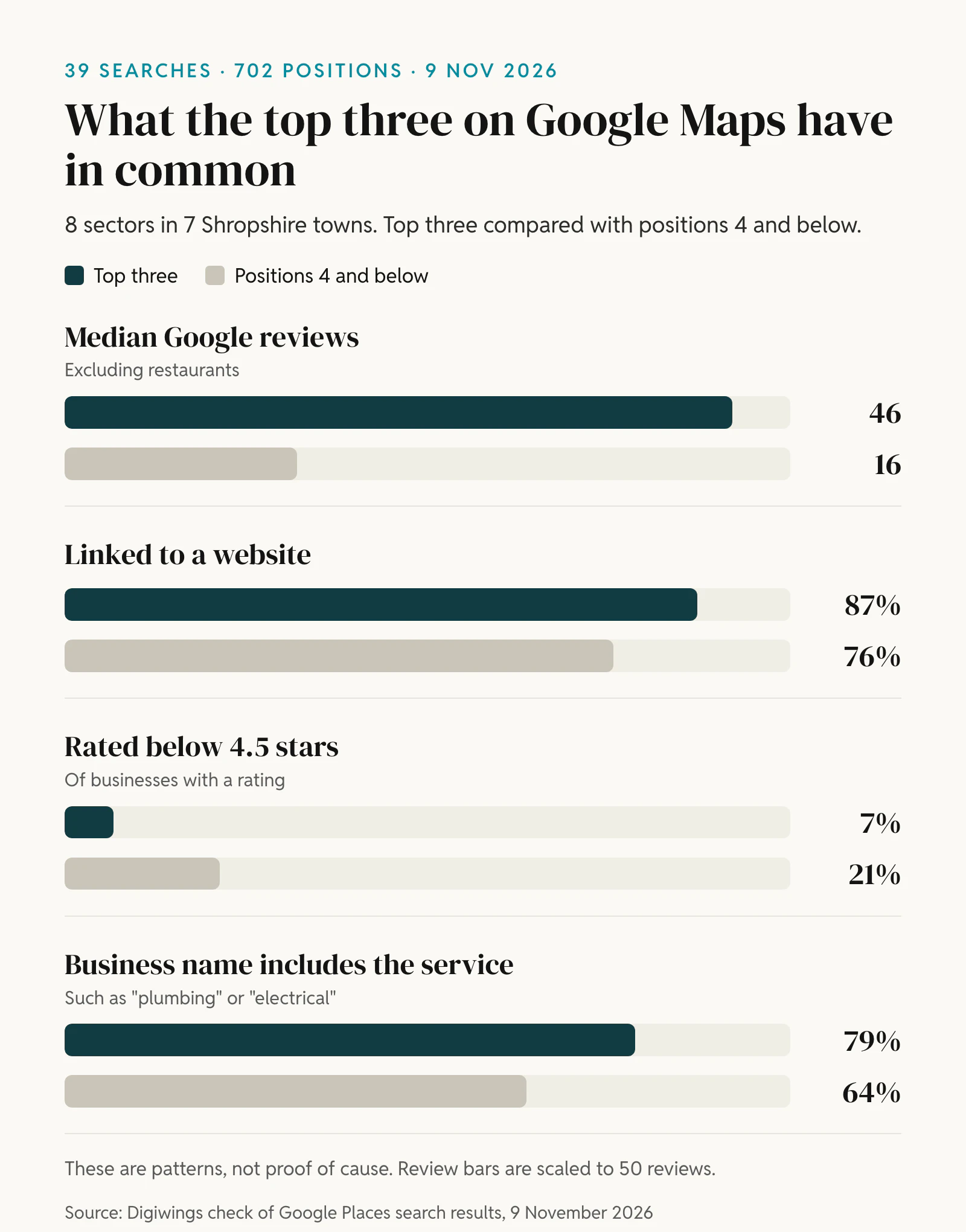
- Reviews matter, but are not everything: outside restaurants, the top three had a median of 46 reviews against 16 for everyone below them. Yet the most-reviewed business came first in only 8 of 39 searches.
- Ratings: 7% of top-three places were rated below 4.5 stars, against 21% of those below them.
- Websites: 87% of top-three places linked to a website, against 76% of the rest.
- Do not add keywords to your business name: names with the service in them ranked higher, but Google can suspend profiles that add words that are not part of the real name.
How does Google decide the order on Google Maps?
Google ranks local results mainly on three things: how relevant a profile is to the search, how far the business is from the searcher, and how well known it is. Its help page on local ranking, checked on 12 November 2026, describes each one:
- Relevance: how well your profile matches what someone searched for. Complete, detailed business information helps Google match it.
- Distance: how far you are from the person searching. If they do not share their location, Google uses what it knows about where they are.
- Prominence: how well known the business is. Google says this draws on information such as how many websites link to you and how many reviews you have, and that "more reviews and positive ratings can help" your local ranking.
The same page says there is no way to request or pay for a better local ranking. Ads can appear above or among the results, marked as sponsored, but they do not change your organic position.
What we found in 39 Shropshire Google Maps searches
We searched Google's business listings for eight types of business in seven Shropshire towns, such as "plumber in Shrewsbury, Shropshire", and recorded the order of the results. We kept the 39 searches that returned at least 10 local businesses, which gave us 702 positions. Then we compared the top three in each search with everyone below them.
| What we measured | Top three | Positions 4 and below |
|---|---|---|
| Median number of Google reviews, all sectors | 60 | 25 |
| Median number of Google reviews, excluding restaurants | 46 | 16 |
| Rated below 4.5 stars | 8 of 117 (7%) | 115 of 537 with a rating (21%) |
| No rating at all | 0 of 117 | 48 of 585 (8%) |
| Linked to a website | 102 of 117 (87%) | 442 of 585 (76%) |
| Business name includes the service | 92 of 117 (79%) | 372 of 585 (64%) |
These are patterns, not proof. A business with many reviews is often also older, better known and better linked, so we cannot say which of these things moved it up. They do match what Google says it looks at.
Do more Google reviews mean a higher ranking?
Usually, but not on their own. In 36 of the 39 searches, businesses with more reviews tended to sit higher, and in 31 of them the top three had more reviews than the businesses below. But the most-reviewed business came first in only 8 searches and made the top three in 19. Five of the 39 businesses in first place had fewer than 10 reviews.
The pattern was strongest for trades and professional services, and absent for restaurants:
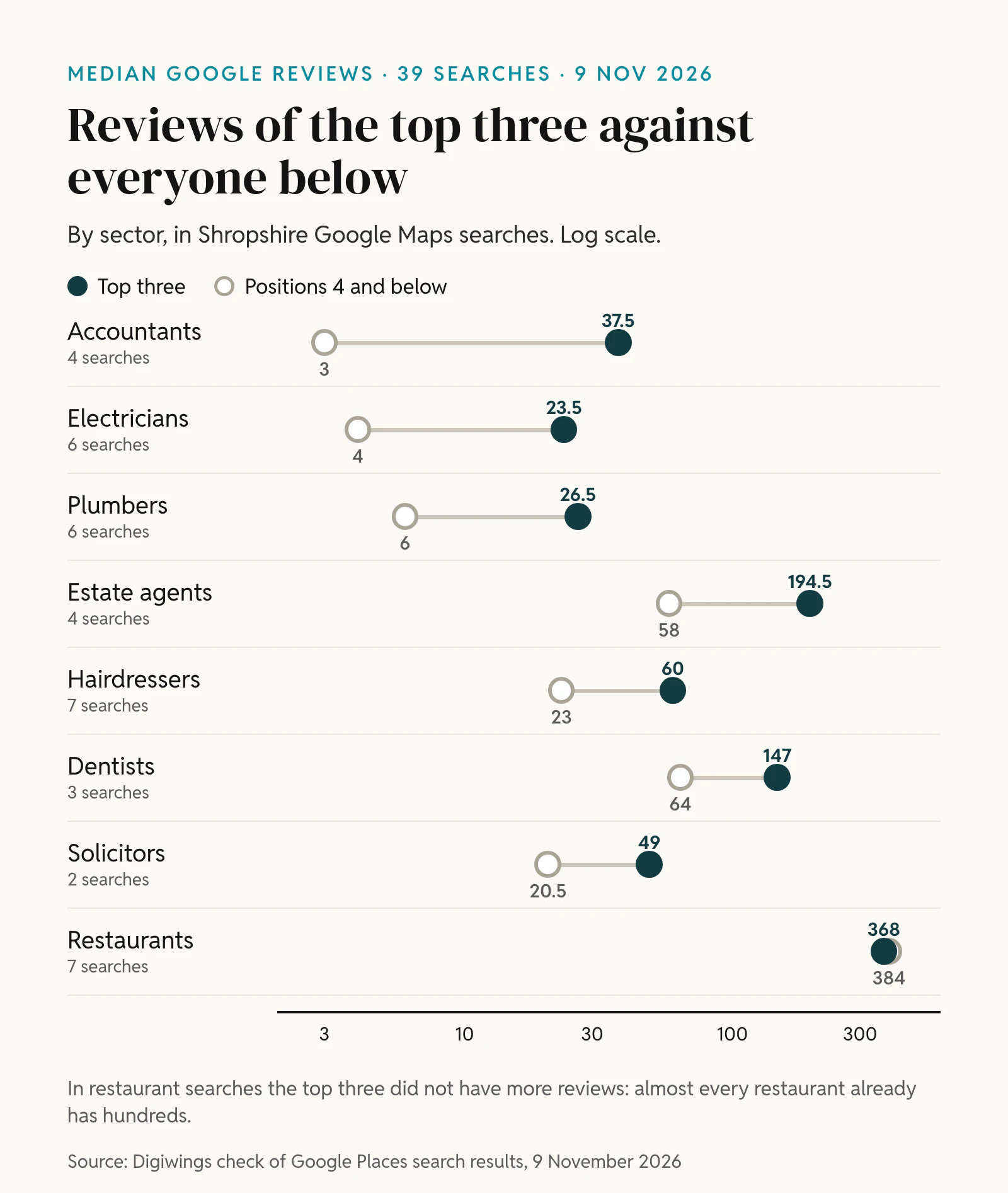
In plumber, electrician and accountant searches, the gap was large: the top three had a median of 23 to 38 reviews, while the businesses below them had 3 to 6. In those sectors, a few dozen genuine reviews can set you apart. In restaurant searches, almost every place already has hundreds of reviews, so they no longer separate one restaurant from another, and other signals take over.
Does your star rating matter?
It seems to. Only 7% of top-three businesses were rated below 4.5 stars, against 21% of the rated businesses below them. Google says positive ratings can help your ranking, and a low rating also puts off the people who see it. The answer is not to chase five-star reviews, which the law and Google's rules forbid you to buy or filter, but to give good service and ask every customer.
Does a website help you rank on Google Maps?
A linked website is common among the leaders: 87% of top-three businesses had one, against 76% of the rest, and 33 of the 39 businesses in first place. Google says the number of websites linking to your business is part of prominence, and your own site is where Google can confirm what you do and where.
Make your website do that job. Name your town or service area in the home page title, show the same business name, address and phone number as your profile, and describe each service on its own page. Our check of 411 Shropshire business websites found that 192 of them (47%) did not name their town or Shropshire in the home page title, so this is an easy gap to close.
Should your business name include keywords?
No. Businesses whose name included the service, such as "plumbing" or "electrical", were more common in the top three: 79% against 64%. But Google's guidelines say your profile name must match your real-world name, as used on your signs, website and stationery. Adding extra words, such as a service or a town, is not allowed and can get your profile suspended.
If you are naming a new business, a name that says what you do can help customers and search alike. If you already trade under another name, do not add keywords to your profile. Put the services in your categories, description and website instead.
Can you rank on Google Maps outside your town?
Rarely near the top. Distance is one of Google's three main factors, so a business usually ranks best for searches made near it, or for searches that name its town. A plumber in Shrewsbury is unlikely to come first for "plumber" searched in Ludlow, however many reviews it has.
If you serve customers at their homes, set up your profile as a service-area business, list the towns you cover and hide your address if customers do not visit you. Then give your main service areas their own pages on your website, with real local detail. That helps you appear for searches that name those towns, such as "electrician in Ludlow", even if it cannot change where your base is.
How to rank higher on Google Maps: a 10-step checklist
- Verify your profile. Google says verified businesses are more likely to show in results.
- Choose the most specific primary category that describes your core business, such as "Electrician" rather than "Contractor". Add only a few secondary categories that are true.
- Use your real business name, with no added keywords or towns.
- Fill in every section: hours, special hours, services, service area, phone, website, attributes and description.
- Add real photos of your premises, team and work, and keep adding new ones.
- Ask every customer for a review, with a direct link, and reply to every review. Never offer a reward or ask only happy customers.
- Link to a website that names your town in the title, shows the same name, address and phone number, and has a page for each service.
- Keep your details the same everywhere, including directories and social profiles, so Google sees one consistent business.
- Earn local mentions and links from suppliers, trade bodies, local news and community sites.
- Check your profile every month for suggested edits by Google or the public, and correct anything wrong.
If your business does not appear at all, start with our seven checks for why a business is not showing on Google, and run our free SEO and AI readiness check on your website.
How can Digiwings help?
Our Local SEO service, from £395 a month, covers your Google Business Profile, your website's local pages and structured data, reviews and local citations, with a monthly report on where you appear. If you want to know where you stand first, send us your business name and town and we will look at your profile, your website and the businesses ranking above you, free of charge. You can also read about our SEO and GEO services or our local pages for Shrewsbury, Telford, Oswestry, Ludlow, Bridgnorth, Market Drayton and Whitchurch.
Frequently asked questions
How do I rank higher on Google Maps?
Verify your Business Profile, choose the right primary category, complete every section, collect genuine reviews and reply to them, and link to a website that names your town and services. Google ranks local results on relevance, distance and prominence, and you cannot pay for a better position.
How many reviews do I need to rank in the top 3 on Google Maps?
There is no fixed number. In our check of 39 Shropshire searches, the top three outside restaurants had a median of 46 reviews against 16 below them, but some first-placed businesses had fewer than 10. Aim to have more recent, genuine reviews than the businesses currently above you.
Can I pay Google to rank higher on Maps?
No. Google says there is no way to request or pay for a better local ranking. You can pay for ads that appear marked as sponsored, but they do not change your organic position.
Why is my competitor ranking above me on Google Maps?
Usually because they are closer to the searcher, their profile matches the search better, or they are better known, with more reviews and links. Compare their primary category, reviews, photos and website with yours.
Does adding keywords to my business name help?
It breaks Google's guidelines unless the words are part of your real-world name, and it can get your profile suspended. Put your services in your categories, description and website instead.
Does my website affect my Google Maps ranking?
It can. Google counts links to your business as part of prominence, and your website confirms what you do and where. In our check, 87% of top-three businesses linked to a website, against 76% of the businesses below them.
How we checked
On 9 November 2026 we ran 56 searches through Google's Places API Text Search, one for each of eight business types (accountant, dentist, electrician, estate agent, hairdresser, plumber, restaurant and solicitor) in seven towns (Shrewsbury, Telford, Oswestry, Bridgnorth, Ludlow, Market Drayton and Whitchurch), in the form "plumber in Shrewsbury, Shropshire". We kept operating businesses with an address in the area, numbered them in the order Google returned them, and analysed the 39 searches with at least 10 results: 702 positions. For each one we recorded the number of reviews, the rating, whether a website was linked, and whether the business name contained the service word. To measure whether more reviews went with higher positions, we used a rank correlation within each search.
The order returned to our script was not personalised and had no searcher location, so it can differ from what a person sees on their phone. Places API types are not the same as Business Profile categories, so we did not analyse categories. We publish totals only, never business names. The summary data is available as a CSV file (CC BY 4.0).
Sources
- Google Business Profile Help, Tips to improve your local ranking on Google, checked through the Internet Archive copy of 12 November 2026.
- Google Business Profile Help, Guidelines for representing your business on Google, checked through the Internet Archive copy of 10 November 2026.
- Google for Developers, Places API Text Search.
- Digiwings, Google Maps ranking check of 39 Shropshire searches, November 2026 (CSV, CC BY 4.0).
Illustration and charts: Digiwings.