How to Get Your Restaurant or Café on Google Maps and Into AI Answers: What Shropshire Data Shows
To get your restaurant or café on Google Maps, search for it in Maps first. If a listing exists, claim it; if not, add it at business.google.com/add. Then verify it and fill in the category, opening hours, menu, photos, and booking or ordering links. That listing matters for AI answers too: asked where to eat, ChatGPT showed ratings, maps and opening hours, and cited restaurants' own websites for just 2 of the 26 places it named.
On 9 November 2026 we asked ChatGPT and Gemini where to eat in seven Shropshire towns and checked 93 local restaurant websites found through Google Maps. Only 13 of the 66 restaurants the assistants named were cited from their own website. This guide sets out what Google documents for restaurant profiles, what our data showed and what to fix first.
In short
- Getting on Maps: claim your listing or add a new one, then verify it. Both are free, and photos only appear once the profile is verified.
- A restaurant profile can hold a full menu with prices, takeaway and delivery hours, booking and ordering links, attributes such as outdoor seating, and photos.
- AI answers: 13 of 66 restaurants named (20%) were cited from their own website, against 30% across eight trades. Late in the evening, ChatGPT recommended only places its listing data showed as open.
- Restaurant websites: 80% show a phone number on the home page, the lowest of eight sectors, and 46% name their town in the home-page title.
- Reviews: ask every table and never offer anything in return. Google prohibits incentives, and UK law bans fake and concealed incentivised reviews.
How do you get your restaurant on Google Maps?
You claim the listing that may already exist, or add a new one, and then verify it. Google's set-up guide for restaurants starts with these steps, and Google says you can add or claim a profile at no charge.
- Search for your restaurant in Google Maps. It may be listed already, because Google compiles profiles from websites, licensed data and people who use Maps.
- If it is listed and unclaimed, select "Claim this business", then "Manage now". In the Maps app, the option is under "About".
- If it is not listed, go to business.google.com/add and select "Add your business to Google".
- If someone else manages it, such as a previous owner or a former agency, request ownership rather than creating a second profile. The current owner has three days to respond.
- Verify it. Google chooses the methods you are offered: phone or text, email, a live video call, a video recording or a postcard. On a video call, be ready to show your signs and kitchen. Reviews take up to five working days.
Two of Google's guidelines catch restaurants out. The name must be your real name: "Including unnecessary information in your business name isn't permitted, and could result in the suspension of your Business Profile." And a restaurant inside a hotel needs its own profile. Pick as few categories as possible, each completing the sentence "This business IS a", such as "Coffee shop".
What should a restaurant put on its Google Business Profile?
Everything a diner checks before choosing: when you are open, what you serve, what it costs and how to book. Google notes that a restaurant's profile can also show things the owner never added, such as customers' photos of meals.
| Profile section | What Google's help pages say | What to do |
|---|---|---|
| Opening hours | Use the hours when diners can sit down and eat. Add More hours for takeaway or delivery, and special hours for closures of up to six days. For seven days or more, mark the business temporarily closed. | Set Christmas and New Year hours before December. |
| Menu | The menu editor holds sections, dishes, descriptions and prices; changes take 24–48 hours to show. Google can generate one from a photo or PDF, and may transcribe one from your website. Sample menus should not be submitted. | Add the full menu with prices, plus a menu link to your own website. |
| Bookings | Connect a Reserve with Google provider, which may charge you, or add your own booking link. Restaurants can also run a waitlist through a provider. | Mark your own booking route as the preferred link. |
| Food ordering | Add collection and delivery links, choose a preferred provider and remove third-party links you do not want. | Check which ordering links appear on your profile. |
| Attributes | Attributes such as outdoor seating, Wi-Fi and wheelchair access can help you appear in searches for places that have them. | Mark every attribute that is true. |
| Photos | Google suggests at least three each of food and drink, the outside and the inside, showing the place as it really is. | Replace photos when the menu or the room changes. |
How does Google decide which restaurants to show?
Google says local results depend on relevance, distance and prominence. Its page on local ranking says prominence draws partly on how many websites link to you and how many reviews you have. It also states: "There's no way to request or pay for a better local ranking on Google."
Our view of what that means for a restaurant: you cannot change distance, so someone on Ludlow's Castle Square will usually see the nearest places first. Relevance comes from your category, menu, attributes and website text: a search for "vegan Sunday lunch" can only match you if those words appear somewhere Google reads. Prominence comes from reviews and from mentions on other sites, and for restaurants the obvious ones are local guides.
If you do not appear even for your own name, see our checks for why a business is not showing on Google.
Where do AI answers about places to eat come from?
In our test, mostly from listing data and local guides, not from restaurants' own websites. On 9 November 2026 we asked ChatGPT and Gemini, signed out on a UK connection, "Where should I eat in [town] (town centre) tonight?" for Shrewsbury, Telford, Oswestry, Bridgnorth, Ludlow, Market Drayton and Whitchurch: 14 answers. The method is in our study of 112 AI answers in Shropshire.
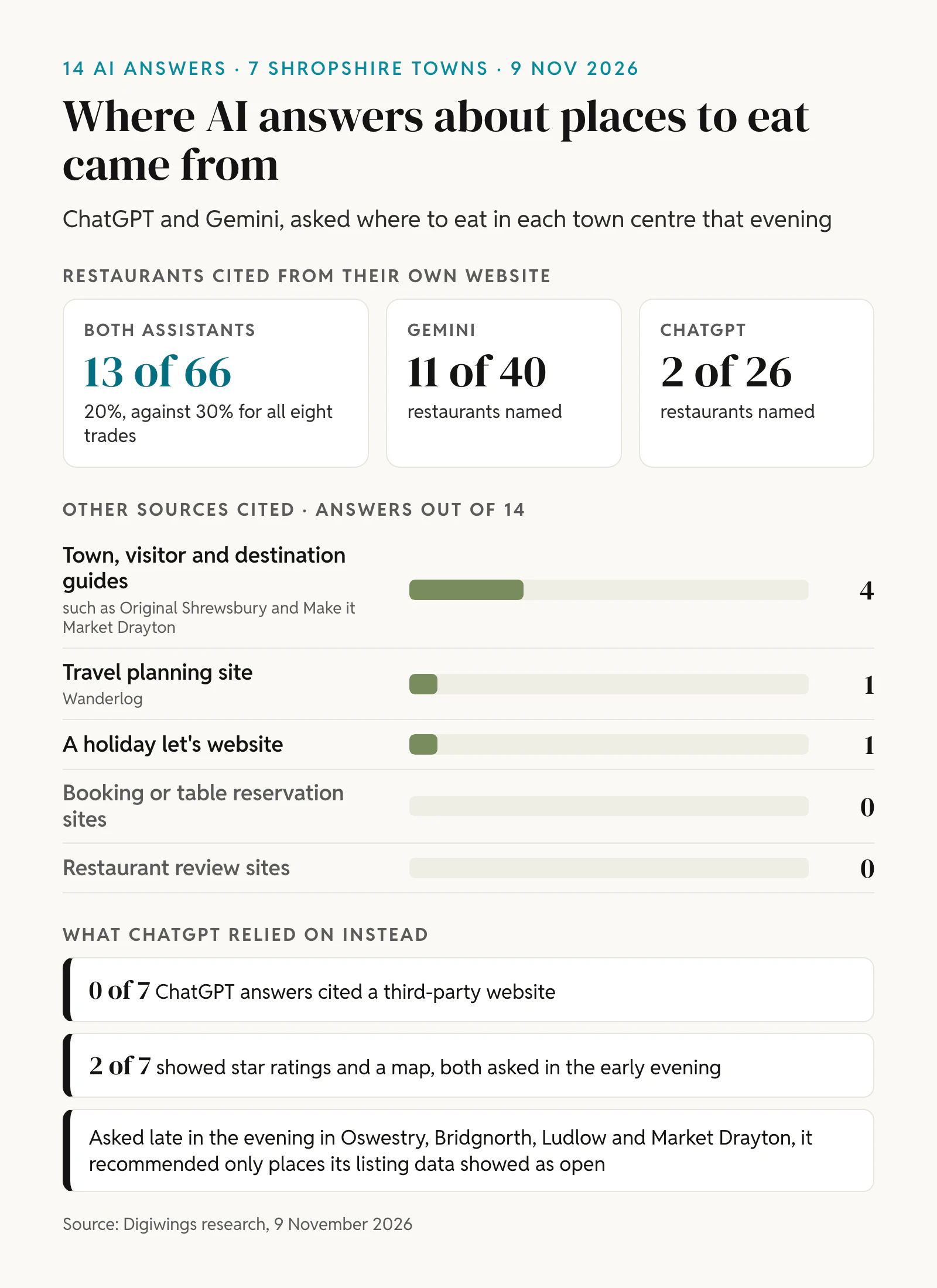
- Own websites were cited for 13 of the 66 restaurants named (20%), against 130 of 435 (30%) across all eight trades in the same test. Gemini cited 11 of its 40 restaurants from their own sites; ChatGPT 2 of 26.
- ChatGPT cited no third-party website in any of its seven answers. In Shrewsbury and Telford, asked in the early evening, it showed star ratings and a map. As we reported earlier: "When we asked late in the evening where to eat in Oswestry, Bridgnorth, Ludlow and Market Drayton, ChatGPT recommended only places its listing data showed as open."
- Gemini's other sources were mostly local guides. Four answers drew on a town, visitor or destination guide: Original Shrewsbury, Southwater's website in Telford, a Bridgnorth town guide and Make it Market Drayton. One answer also cited Wanderlog, a travel planner, and a holiday let's website.
- No booking platform or review site was cited in any of the 14 answers.
- Whitchurch was ambiguous. ChatGPT asked whether we meant Shropshire or Whitchurch-on-Thames. Gemini split its answer between Shropshire and Hampshire.
Some names were national chains, including two of ChatGPT's five in Telford. Fourteen answers are a dated snapshot, not a rule.
Our view: for "where to eat tonight", the listing behind the answer counts for more than the website. ChatGPT does not say where its listing data comes from, so we cannot say it is Google's, but accurate hours on every listing are the cheapest fix there is. Next, check how your town's visitor guide lists you. Then give Gemini something to cite: a website that says what you serve, where and when.
How do Shropshire restaurant websites compare?
They trail other local businesses on the basics and lead on structured data. We checked 93 independent restaurant websites in the seven towns against 318 businesses in seven other sectors, all found through Google Maps.
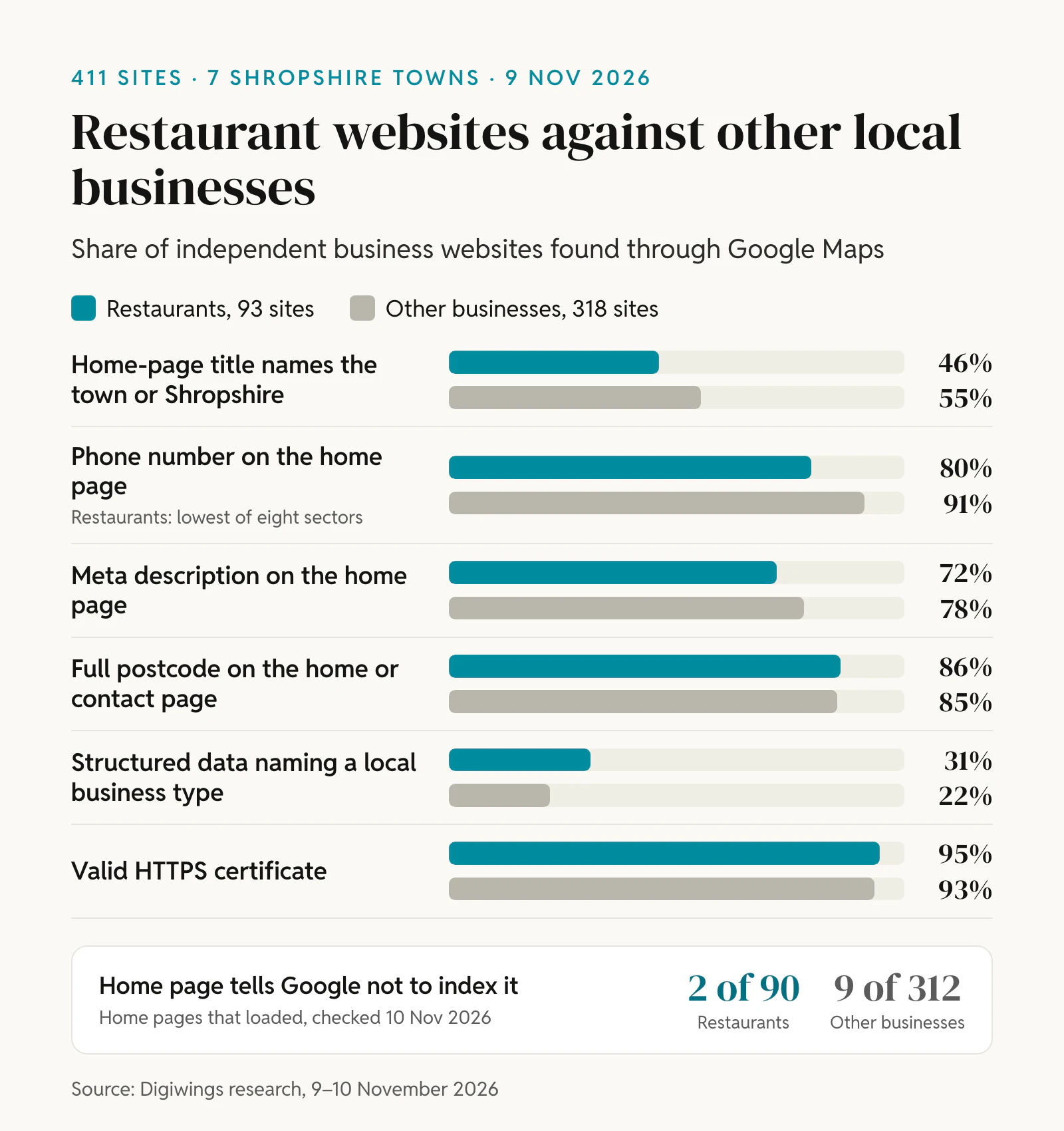
- 43 of 93 home-page titles (46%) named the town or Shropshire, against 55% for other businesses.
- 74 of 93 (80%) showed a phone number on the home page, against 91%. That was the lowest of the eight sectors, below hairdressers at 82%.
- 67 of 93 (72%) had a meta description, the summary search engines may show under the title, against 78%.
- Only 28 of 93 (30%) had all four basics: a title naming the place, a phone number on the home page, a meta description and a full postcode. For other businesses it was 134 of 318 (42%).
- Restaurants led on structured data: 31% described themselves as a local business type, such as Restaurant, against 22%.
- 2 of the 90 restaurant home pages that loaded told Google not to index them, both with the tag WordPress adds when "Discourage search engines from indexing this site" is ticked.
Our view: fix the phone number first. People ring restaurants to book or to check a dietary need, so a missing number costs bookings before it costs rankings.
What should a restaurant website include?
The facts a diner and a search tool both need, in plain text: what you serve, where, when, what it costs and how to book.
- A home-page title with your cuisine and town, such as "Thai Restaurant in Ludlow, Shropshire | [Name]".
- Your phone number on every page, as a link people can tap.
- Your full address and postcode, with parking and directions.
- Opening hours that match your Business Profile, including kitchen times.
- The menu as a web page, not only a PDF or photo, with dishes, prices and dietary notes in text. Google says it "may transcribe menu data from your business website" for your profile, and its AI features guide advises keeping important content in text.
- One clear booking route, the same link as on your profile.
- Restaurant structured data. Google's local business documentation says to use the most specific type, such as Restaurant, and supports menu, cuisine, opening hours and price range. Google does not guarantee any resulting feature, and recommends rating markup only for sites that review other businesses, so do not mark up your own reviews.
Example: a restaurant in Rayleigh, Essex
Charcoal & Earth opened in Rayleigh, Essex, in 2020. We built its WordPress website and managed its Google Business Profile, SEO, social media and paid campaigns from the start. Its menus were built as web pages with dishes, descriptions, prices and dietary notes, not as PDFs. On 24 September 2026, PageSpeed Insights showed the site passing the mobile Core Web Vitals assessment in real-user data. It continues to trade under new ownership. We have no dated analytics to publish, so we make no ranking or traffic claim. See the Charcoal & Earth case study.
How do you get more Google reviews without breaking the rules?
Ask every customer, make it easy and never give anything in return. Google's tips on reviews suggest a review link or QR code and replies to reviews. Its content policy does not allow businesses to:
- offer payment, discounts or free food or drink for a review, or for changing or removing a negative one;
- discourage negative reviews, or ask only the customers they expect to be positive;
- pressure customers to review while still on the premises, or ask staff to collect a set number of reviews or reviews that name them.
Google removes such reviews and can restrict the profile: blocking new reviews for a time, hiding existing ones or showing a warning that fake reviews were removed.
UK law covers the same ground. The Competition and Markets Authority's fake reviews guidance (CMA208) explains a ban under the Digital Markets, Competition and Consumers Act 2024 on fake reviews and reviews that hide an incentive, behaviour it calls "automatically unfair and illegal". Commissioning a review can include "a trader requesting a member of staff to write a review", and encouraging only satisfied customers can amount to cherry-picking. The CMA says a prize draw is unlikely to count as commissioning, but Google's policy still does not allow incentives for a review on Maps.
In practice: put the QR code on every bill, not only for tables that seemed happy.
How can Digiwings help?
We build websites and run local SEO for Shropshire businesses from our studio in Shrewsbury. Send us your restaurant's website and we will check your Google profile, your menu page and what ChatGPT and Gemini say about places to eat in your town, free of charge. You can also try our free SEO and AI readiness check, or our Small Business Saturday checklist for a wider pre-Christmas check. If the site needs replacing, our Advanced web design package includes a dynamic content page for menus your team can update without a developer. Our Local Dominance retainer covers Google Search, Maps and your Business Profile, and each town's results are on its own page, such as SEO in Shrewsbury, Ludlow and Bridgnorth.
Frequently asked questions
How do I get my restaurant or café on Google Maps?
Search for your business in Google Maps. If it is listed, select "Claim this business"; if not, add it at business.google.com/add. Then verify it using a method Google offers, such as phone, email, video or postcard. It is free.
How long does it take for a restaurant to show on Google Maps?
Google says verification reviews take up to five working days, and most postcard codes arrive within 14 days. Menu changes can take 24–48 hours to appear. Where you then rank depends on relevance, distance and prominence.
How do I add my menu to Google?
In your Business Profile, select "Edit menu" and add sections, dishes and prices, or upload a photo or PDF and check the menu Google generates. Add a menu link to your own website as well. Google may transcribe menu data from your website, so keep that page in text and up to date.
Is it free to put my restaurant on Google?
Yes. Adding or claiming a Business Profile costs nothing, and Google says there is no way to pay for a better local ranking. Some booking providers that connect to your profile may charge you.
How do I get my restaurant recommended by ChatGPT?
In our Shropshire test, ChatGPT relied on listing data such as ratings and opening hours, and late in the evening it recommended only places shown as open. Keep your hours accurate on every listing. Gemini cited own websites for 11 of 40 restaurants, so a website with a text menu, address and hours helps too.
Can I offer customers a discount for a Google review?
No. Google treats discounts or free items for a review as fake engagement, removes those reviews and can restrict your profile. In the UK, fake reviews and reviews that hide an incentive are banned, as the CMA's guidance CMA208 explains.
How we checked
The 93 restaurants are part of the 411 independent businesses in our Shropshire study, in eight sectors, whose Google Maps listing named one of the seven towns as the postal town and linked to a website. National chains were removed. Our crawler read each home and contact page on 9 November 2026; a second check for noindex rules on 10 November 2026 loaded 90 of the 93 restaurant home pages. The AI questions were asked once each on 9 November 2026, in the early evening for Shrewsbury and Telford and late at night for the other towns. A restaurant counted as cited from its own website when the assistant linked to it or showed it as a source; we grouped other sources by type. Samples are small and answers vary between runs. We name no business; totals are in our restaurant data and local search readiness data (CSV, CC BY 4.0).
Sources
Our own data was collected on 9 and 10 November 2026. Google and CMA pages were checked on 10 November 2026.
- Digiwings, Restaurant websites and AI answers about places to eat, Shropshire, November 2026, Local search readiness, November 2026 and Indexing check, November 2026 (CSV, CC BY 4.0).
- Google Business Profile Help, Get started with a Business Profile for your restaurant.
- Google Business Profile Help, Add or claim your Business Profile and Request ownership of a Business Profile.
- Google Business Profile Help, Verify your business on Google.
- Google Business Profile Help, Guidelines for representing your business on Google.
- Google Business Profile Help, Understand how Google sources & uses info in Business Profiles & local search results.
- Google Business Profile Help, How to set More hours and How to set special hours.
- Google Business Profile Help, About the menu editor.
- Google Business Profile Help, Set up bookings through a provider, Manage your local business links and Manage online ordering options.
- Google Business Profile Help, Manage your business attributes.
- Google Business Profile Help, Tips for business-specific photos on your Business Profile and Manage your Business Profile photos and videos.
- Google Business Profile Help, Tips to improve your local ranking on Google.
- Google Business Profile Help, Tips to get more reviews and Business Profile restrictions for policy violations.
- Maps User Contributed Content Policy Help, Prohibited and restricted content.
- Google Search Central, Local business (LocalBusiness) structured data, last updated 8 September 2026.
- Google Search Central, AI features and your website, last updated 10 December 2025.
- Competition and Markets Authority, Fake reviews guidance (CMA208), 4 April 2025.
- Original Shrewsbury, The official guide to Shrewsbury.
Illustration and charts: Digiwings.