PHP2Shell: 3 Questions Shropshire Businesses Should Ask Their Web Host
On 21 October 2026, the PHP project released emergency fixes for two critical vulnerabilities, CVE-2026-109618 and CVE-2026-109619, now widely reported as "PHP2Shell". They can allow an attacker to run code on a web server without logging in. If your business website runs on WordPress, WooCommerce or any other PHP software, the fix has to be applied on the server, and WordPress cannot apply it for you.
The quickest way to find out where you stand is to ask whoever hosts your website three questions, and to get the answers in writing.
In short
- What: two critical PHP flaws, each rated 9.2 out of 10 (CVSS v4.0), fixed on 21 October 2026.
- Fixed versions: PHP 8.5.12, 8.4.27, 8.3.36 and 8.2.35, or a vendor backport for older versions.
- Your action: ask your host which PHP version you run, whether both fixes are applied and whether PHP has been restarted since.
- Not enough on its own: updating WordPress, themes or plugins. PHP is server software.
What is PHP2Shell?
PHP is the programming language that runs on the server behind WordPress, WooCommerce, Joomla, Drupal and Magento. On 21 October the PHP project published a security advisory stating that PHP 8.5.12, 8.4.27, 8.3.36 and 8.2.35 "fix two critical vulnerabilities that can allow unauthenticated remote code execution". In plain English, an attacker may be able to make your server run their commands without needing a password.
"PHP2Shell" is the nickname used in security reporting; the PHP project's own advisory refers to the CVE numbers. Both vulnerabilities are rated 9.2 out of 10 on the CVSS v4.0 scale. The advisory says the risk is highest for servers using mod_php, and Help Net Security reports that other common set-ups, including PHP-FPM and LiteSpeed, are affected too. The PHP project is clear that there are no complete mitigations: updating is the only safe choice.
Why does PHP2Shell matter for small businesses?
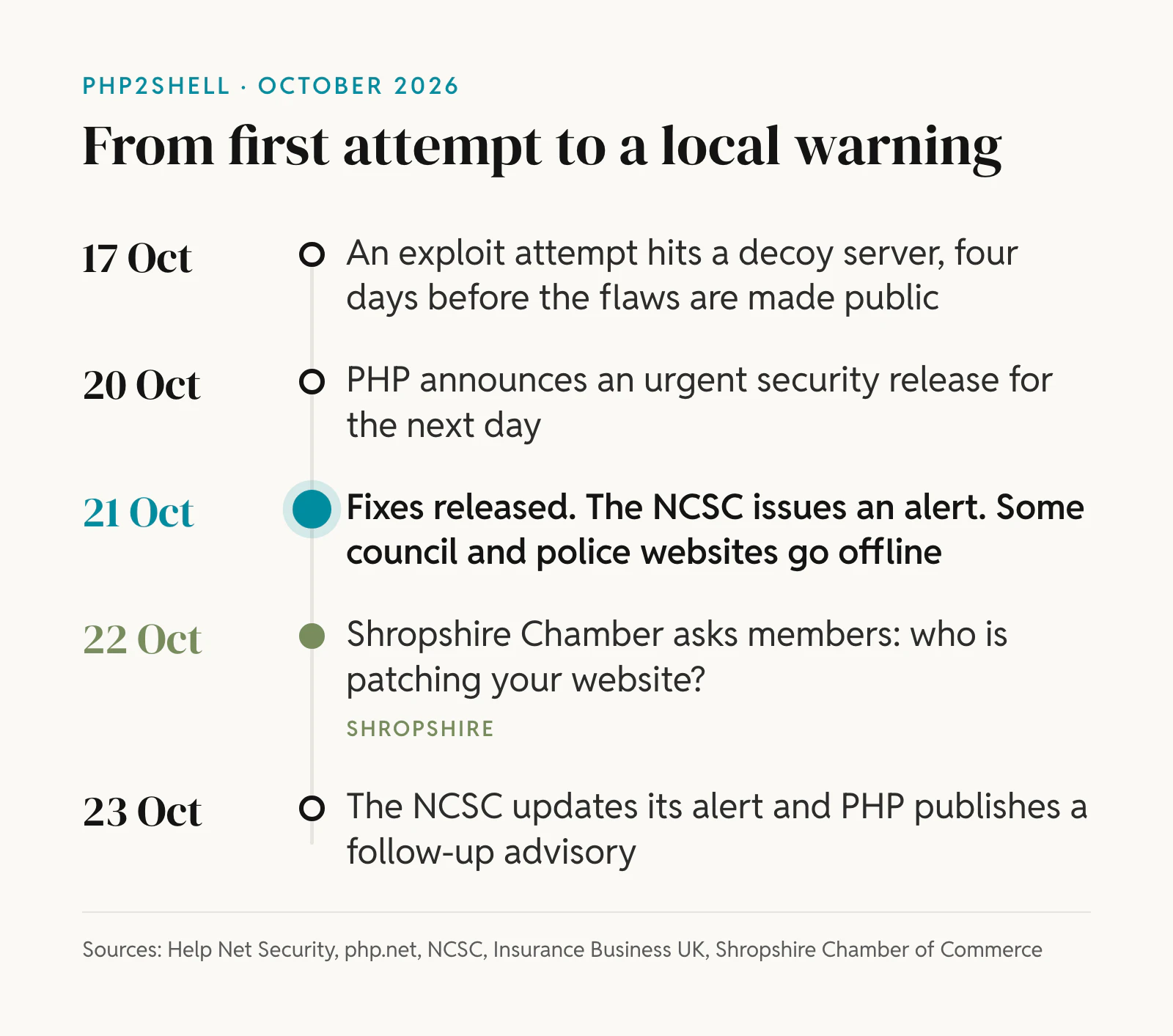
The UK's National Cyber Security Centre (NCSC) published an alert on 21 October and updated it on 23 October. It tells organisations to find every PHP installation, update internet-facing systems first, use the PHP project's temporary mitigations if they cannot update, and consider taking a system offline if neither can be done quickly.
Some public bodies did exactly that. Insurance Business reported on 21 October that websites for Edinburgh and Oxford councils and the Metropolitan Police were unavailable following the alert. The same report quotes Cloudflare's chief technology officer saying the company had seen early attacks before the fixes were released, although no successful break-ins had been confirmed at that point. Help Net Security reported that Amazon's threat intelligence team recorded an exploitation attempt against one of its decoy servers on 17 October, four days before the flaws were made public.
Our view: being a small business does not make a website a smaller target. Attacks of this kind are usually automated and scan the internet for any vulnerable server, whoever owns it. A compromised website can be used to steal customer data, send spam or redirect visitors elsewhere, and cleaning one up costs far more than checking it now.
Why won't WordPress updates fix PHP2Shell?
WordPress, its themes and its plugins are applications that run on top of PHP. PHP itself is installed on the server. As WordPress.org explains, your hosting company determines which versions of PHP are available for your site. Automatic WordPress updates and security plugins do not change the PHP running underneath.
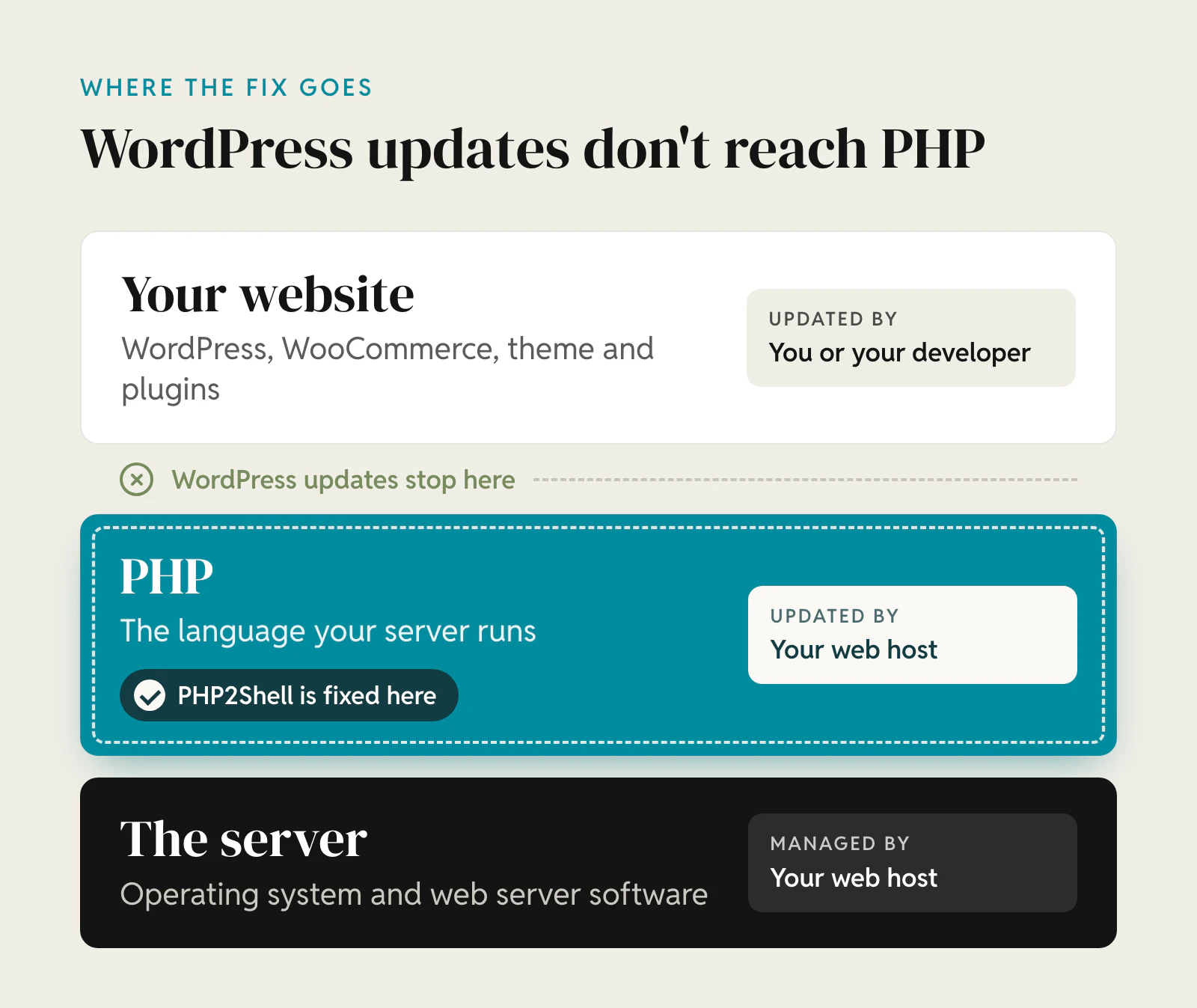
The same is true of other PHP platforms. Whoever manages the server, whether that is a hosting company, an agency or an IT supplier, is responsible for applying the fix. Hosted website builders such as Wix and Squarespace run their own servers, so their customers have nothing to patch themselves.
Which three questions should you ask your web host?
Albrighton-based cyber security consultancy Solusec set out these three questions in a Shropshire Chamber of Commerce member article on 22 October, and we agree with them. Send them by email so that you have a dated, written answer.
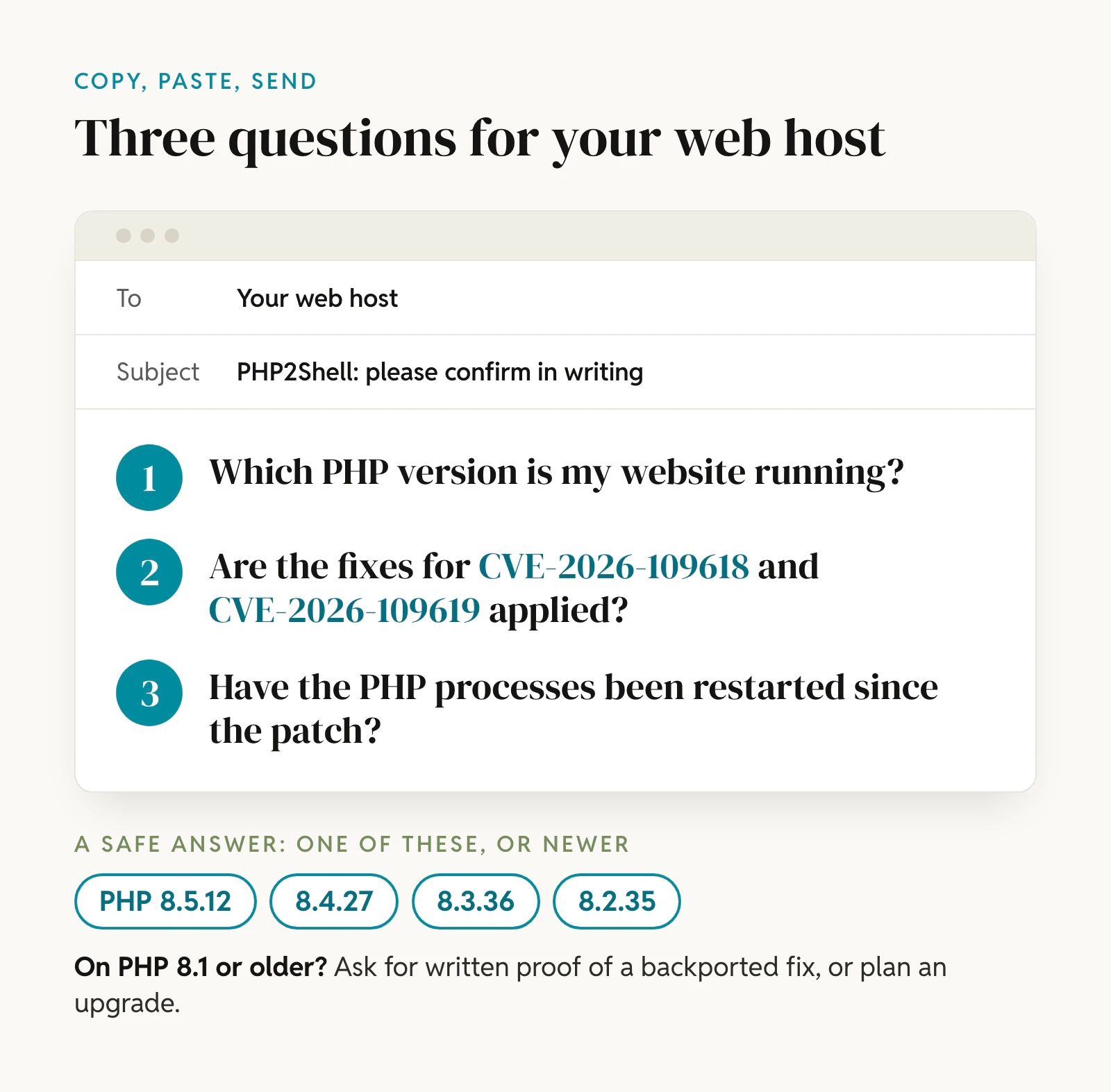
1. Which PHP version is my website running?
The fixed releases are 8.5.12, 8.4.27, 8.3.36 and 8.2.35, or anything newer in the same branch. If the answer is PHP 8.1 or older, take note: the PHP project says these versions no longer receive updates from the project, and only some Linux distributions and long-term-support vendors provide backported fixes. In that case, ask for written confirmation that a backported fix is installed, or plan an upgrade to a supported version.
If you are on PHP 8.2, the fix is available, but the PHP project says 8.2 reaches end of life on 31 December 2026. Plan the next upgrade now rather than in another emergency.
Some vendors apply security fixes without changing the version number, so the number alone does not prove a site is safe. That is why the second question matters.
2. Have the fixes for CVE-2026-109618 and CVE-2026-109619 been applied?
Ask about both CVE numbers by name. A good answer says how the fix was applied, through an updated PHP release or a vendor's patched package, and when. "We're on it" is not an answer you can rely on.
3. Have the PHP processes been restarted since the patch?
A patch on disk does nothing until the services that run PHP are restarted, because the running processes keep the old code in memory. Hosting companies normally restart them as part of the update, but it costs nothing to confirm.
What if your host can't patch straight away?
The PHP advisory lists temporary measures, such as changes to memory_limit, post_max_size and session.upload_progress.enabled, but says they do not make an installation safe. A follow-up advisory on 23 October also recommends switching off session upload progress until the next bugfix release. These are server settings for your host or developer, not something to change by trial and error.
If neither patching nor mitigation can be done quickly, the NCSC says to consider taking the system offline. If you do, protect your search visibility:
- Return a 503 status, not an error page that says "200 OK". Google's John Mueller advised serving the 503 from outside PHP, for example at the CDN or by pointing DNS elsewhere, as Search Engine Journal reported on 21 October.
- Keep it short. Google's crawling documentation advises against returning these status codes for longer than one to two days, and warns that URLs which return them for multiple days may be dropped from Google's index.
What should you avoid?
- Running "PHP2Shell checker" scripts from the internet. The Shropshire Chamber article warns that some of them contain malware. Don't upload anything to your server that your host or developer has not approved.
- Assuming WordPress updates are enough. They are worth doing, but they don't touch PHP.
- Accepting a verbal "it's fine". A written answer is a record you can rely on later, including with an insurer.
- Waiting for signs of trouble. If your site could not be patched quickly, the NCSC advises checking it for signs of compromise and backdoors, and using an NCSC-assured Cyber Incident Response provider if you are not confident doing that yourself.
How did Digiwings handle PHP2Shell for its clients?
When the PHP advisory was published on 21 October, we worked through these same checks for the client websites we support. All of them came through without any data loss or a successful attack.
The lesson for any business owner is that speed depends on knowing who controls your server before an alert like this arrives. Many of the small business websites we see across Shropshire run on WordPress with shared hosting. If you don't know who manages the PHP version on yours, find out now, while nothing is wrong.
A website with less server-side code also has less to patch. Static sites serve most pages without running PHP at all, but anything that does run PHP, even a contact form handler, still needs the fix.
If you are not sure who hosts your website, which PHP version it runs or whether these fixes are in place, get in touch and we will help you find out. If you would rather not deal with this again, our hosting and maintenance plans include UK hosting, daily backups kept for 30 days and manually reviewed WordPress security updates.
Frequently asked questions
Is my WordPress website affected by PHP2Shell?
If it runs on a server where PHP handles web requests, it is exposed until your host applies the fix. The flaw is in PHP, not in WordPress, so your WordPress version makes no difference.
Will updating WordPress or my plugins fix PHP2Shell?
No. WordPress, themes and plugins run on top of PHP. The fix has to be applied to PHP on the server by your hosting company or whoever manages the server.
Which PHP versions fix PHP2Shell?
PHP 8.5.12, 8.4.27, 8.3.36 and 8.2.35, released on 21 October 2026, or later releases in those branches. PHP 8.1 and older no longer receive updates from the PHP project and need a vendor's backported fix or an upgrade.
Should I take my website offline?
Only if your host cannot patch it or apply the temporary mitigations quickly, which is what the NCSC advises. If you do, serve a 503 status from outside PHP and keep the downtime to a day or two to protect your Google rankings.
My website is on Wix or Squarespace. Do I need to do anything?
Hosted website builders manage their own servers, so there is nothing for you to patch yourself. If you are unsure, check the platform's status or security announcements page.
Sources
The facts in this article were checked against these sources on 24 October 2026.
- PHP project, Security advisory: Critical remote code execution vulnerabilities, update now, 21 October 2026, and the related release and follow-up notices in the same archive.
- National Cyber Security Centre, Critical security issue affecting PHP, 21 October 2026, updated 23 October 2026.
- Help Net Security, PHP2Shell vulnerabilities patched, 21 October 2026.
- Insurance Business UK, UK councils and Met Police among sites pulled offline after NCSC alert, 21 October 2026.
- Search Engine Journal, Google reminds sites to serve 503s during server downtime, 21 October 2026.
- Google Search Central, Reduce the Googlebot crawl rate.
- WordPress.org, Update PHP.
- Shropshire Chamber of Commerce, PHP2Shell: Who is patching your website this week?, 22 October 2026.
Illustrations: Digiwings.