Is Your Black Friday Sale Legal? Countdown Timers, ‘Was’ Prices and Hidden Fees After the CMA’s £6m Fines
On 14 October 2026, the Competition and Markets Authority (CMA) fined three businesses about £6 million in total for sales tactics that appear on many small business websites: countdown timers that meant nothing, paid extras added by default and a headline price that left out a compulsory fee. With Black Friday on 27 November and Cyber Monday on 30 November, now is the time to check your own sale pages.
The short answer: a Black Friday sale is legal when the deadline is real, the "was" price is one you genuinely charged, extras are opt-in and the first price customers see includes every compulsory charge.
In short
- The fines: Wayfair £4.8m, Appliances Direct £1.2m and Gold's Gym £45,000, announced by the CMA on 14 October 2026.
- Countdown timers: only for a real deadline that does not reset or roll on.
- "Was" prices: only a price you really charged. The CMA's detailed rules are under review.
- Fees: the headline price must include compulsory charges, and delivery must be clear before checkout.
- Add-ons: never pre-tick a paid extra.
What did the CMA fine businesses for in October 2026?
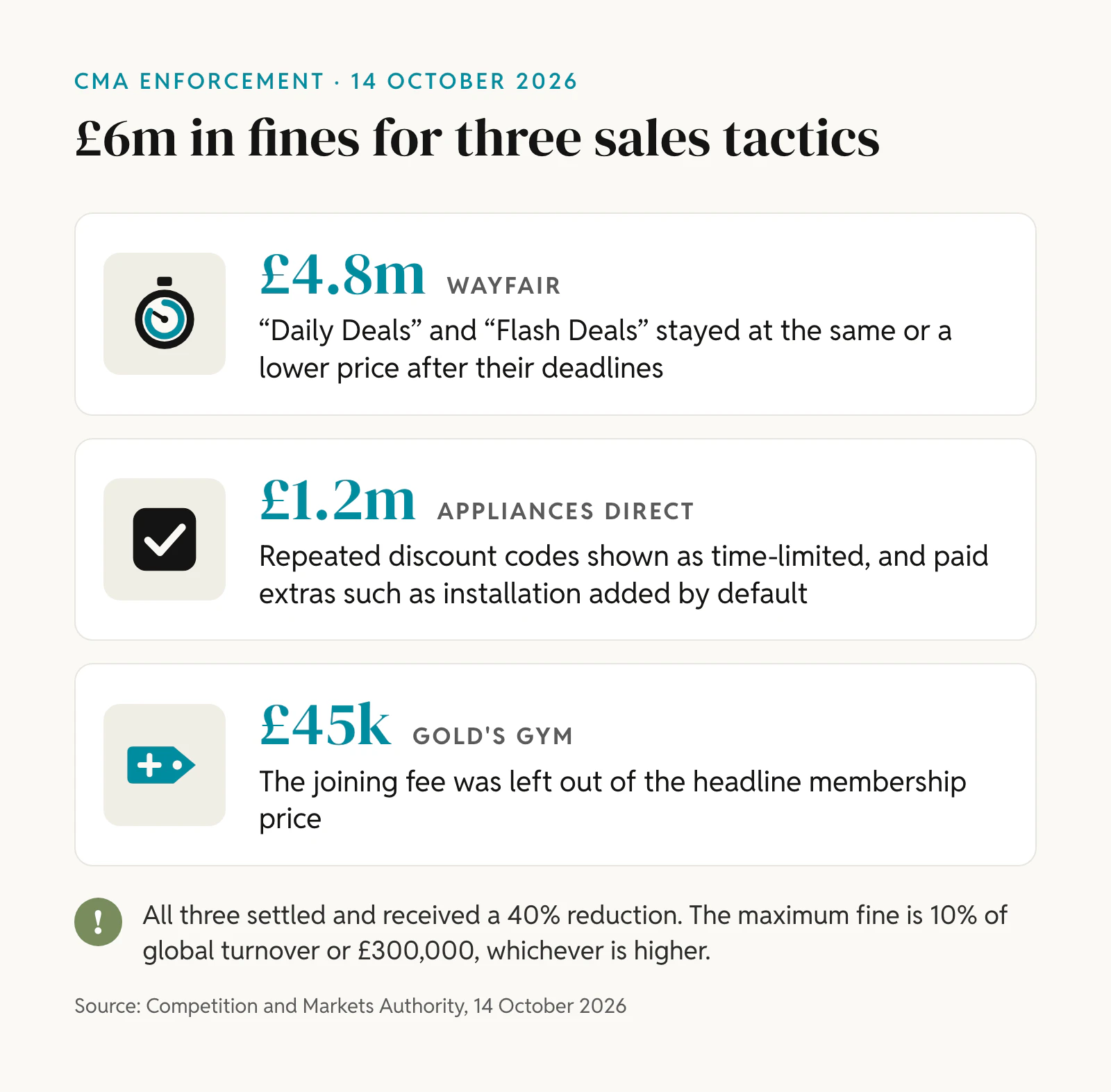
The CMA announced the fines on 14 October 2026. Wayfair was fined £4.8 million because its "Daily Deals" and "Flash Deals" stayed available at the same or lower prices after their stated deadlines. Appliances Direct was fined £1.2 million for presenting repeated discount codes as time-limited and for automatically opting customers into paid extras such as installation and old-appliance removal. Gold's Gym was fined £45,000 for not showing the total membership price, including its joining fee, clearly and upfront.
All three settled and received a 40% reduction. Appliances Direct must also refund about £432,000 to customers, and Gold's Gym must refund £9,220 to 726 customers.
Our view: none of these tactics is unusual. Countdown banners, pre-selected add-ons and "from" prices are standard options in e-commerce themes, booking systems and plugins. That is what makes these cases relevant to small businesses, not just big retailers.
Do these rules apply to small businesses?
Yes. The consumer protection rules in the Digital Markets, Competition and Consumers Act 2024 (DMCC Act) apply to any business selling to UK consumers, whatever its size. Since April 2025 the CMA has been able to decide consumer law cases and fine businesses itself, up to 10% of global turnover or £300,000, whichever is higher. Local Trading Standards services enforce the same rules.
In a blog post published on the same day, the CMA said it had opened 20 investigations under these powers and imposed more than £11.8 million in fines. It added that it is "watching for businesses who might be using misleading discounts".
Are countdown timers legal?
A countdown timer is legal when it counts down to a real deadline. The DMCC Act lists 32 practices that are banned outright, whatever their effect. One of them, in Schedule 20, paragraph 7, is falsely stating that a product will only be available for a limited time to push customers into an immediate decision.
In its guidance on urgency claims, the CMA gave examples of timers it considers misleading:
- the sale price rolls on beyond the advertised end point;
- the same sale price is offered again very soon after the deadline;
- a checkout timer starts again when the page is refreshed, or restarts as soon as it runs out.
The CMA has taken these cases to court. In May 2026, as part of a settlement confirmed by the High Court, Emma Sleep admitted using misleading countdown timers, according to the CMA's case page.
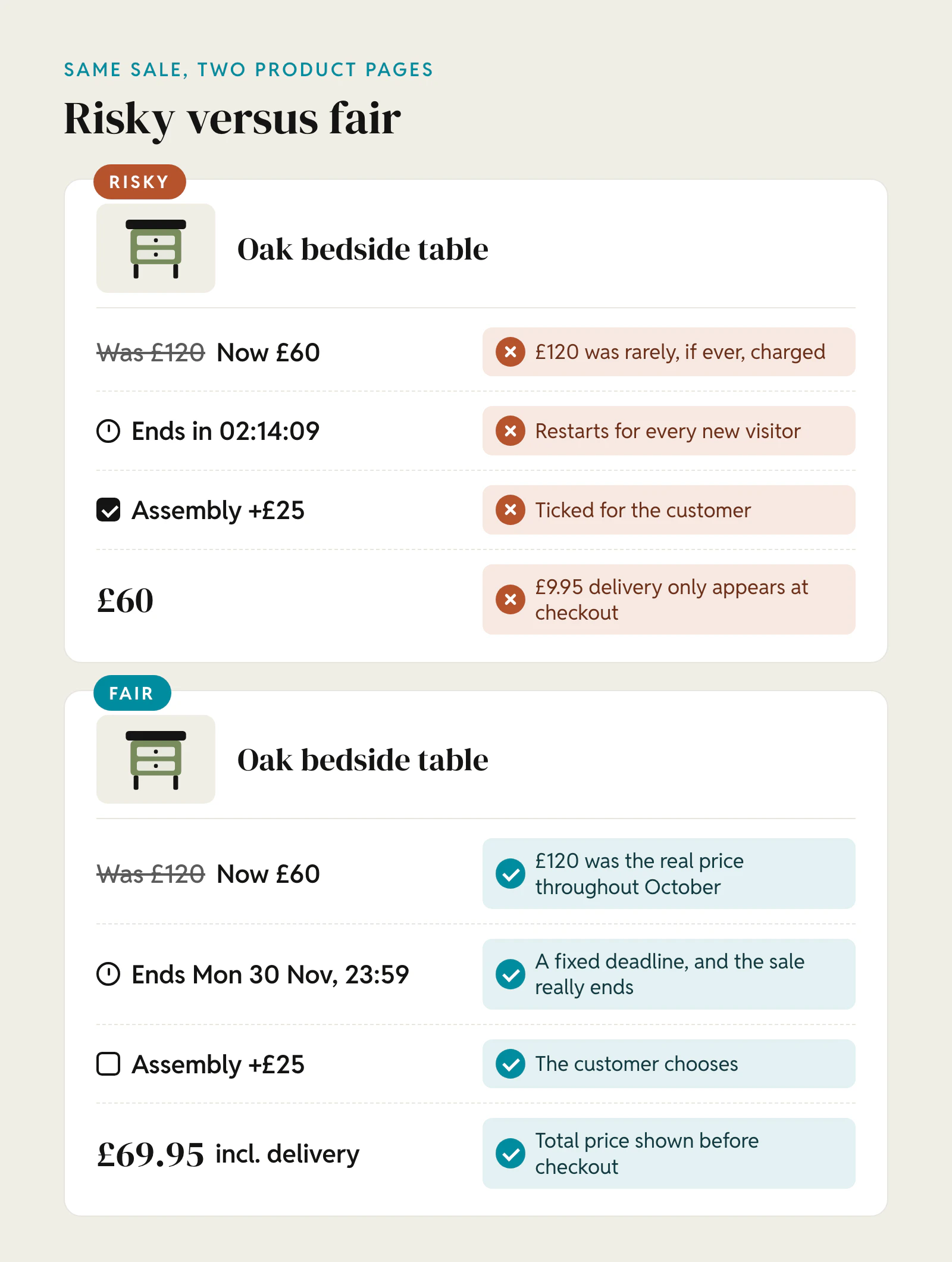
Many website plugins offer "evergreen" timers that restart for each new visitor. Our view: do not use them on a site that sells to UK consumers. If you want a timer, point it at the actual end date and make sure the offer genuinely ends.
Can you still use "was" prices?
Yes, if the comparison is honest. The CMA's October 2026 blog puts it plainly: "Discounts must be genuine." Its 2023 guidance warns against comparison prices that no longer reflect an item's usual price, for example where a "sale" price has quietly become the normal price.
How long a higher price must have been charged is less settled. In 2024 the CMA published detailed "was/now" principles for online mattress sellers, but it temporarily withdrew them on 30 July 2026 while it considers the High Court's judgment in its case against Emma Sleep. Until the CMA says more, a cautious approach is:
- compare only with a price you actually charged, on the same website, immediately before the sale;
- charge that price for a meaningful period, not just a few days;
- keep a dated record, such as screenshots or a price history export, of what you charged and when.
Do delivery charges and booking fees have to be in the price?
Compulsory charges do. The CMA's price transparency guidance (CMA209), published on 18 November 2025, says that showing an initial headline price and then adding mandatory charges as the customer goes through checkout, known as drip pricing, is prohibited. Gold's Gym's joining fee is an example. The same applies to booking fees, admin fees and service charges that every customer has to pay.
Delivery has its own rules in the guidance. Where a mandatory delivery charge is fixed, CMA209 says it should generally be included in the total price. Where one delivery charge applies to a basket of several items, the guidance accepts other ways of showing the total, including:
- showing the delivery-inclusive total alongside the product price;
- a clear running total, such as a sticky basket, that includes delivery and updates as items are added;
- building delivery into the product price and offering free delivery.
The CMA also says it is reviewing how online retailers show delivery fees and expects to give an update shortly, so this is an area to watch before Christmas.
Can you pre-tick paid extras?
No. Under regulation 40 of the Consumer Contracts Regulations 2013, a business cannot charge for an extra unless the customer expressly agreed before buying. Consent cannot be inferred from a default option, and the regulation's own example is a pre-ticked box on a website. If a business takes the payment anyway, it has to refund it.
Appliances Direct's fine included automatically opting customers into paid extras. Gift wrapping, assembly, installation, extended warranties, priority delivery and insurance should all start unticked.
A Black Friday checklist for your website
Before your sale goes live, check that:
- every timer counts down to a fixed end date, and the offer really ends then;
- the same discount does not reappear straight after it "ends";
- every "was" price is one you charged on the same site just before the sale, and you have a dated record of it;
- the first price customers see includes every compulsory fee;
- delivery costs are clear before checkout, either in the price or in a visible running total;
- paid extras are unticked by default;
- stock and popularity messages, such as "Only 3 left", are true and based on real data;
- reviews are genuine. Fake reviews and reviews that hide an incentive are also on the banned list, in Schedule 20, paragraph 13;
- you keep screenshots of each sale page as it went live.
What does this mean for Shropshire businesses?
The rules are the same for a national retailer and a Shrewsbury gift shop. The difference for a small business is the risk of an off-the-shelf plugin or booking system doing something the owner never consciously chose.
The October cases map closely onto local businesses: a gym or leisure club with a joining fee, a furniture or appliance shop offering paid installation, a hotel or venue adding a booking fee, or a shop promoting a flash sale on social media that links to a countdown page. Black Friday is followed by Small Business Saturday on 5 December, when many Shropshire independents run their own offers, so it makes sense to check your sale pages once for both.
How can Digiwings help?
Most of these fixes are small website changes: a timer tied to a real date, a delivery line on the product page, an unticked box. If you would like a second pair of eyes on your sale pages before 27 November, get in touch, or see how we approach web design.
We look at sale pages as a web team, not as lawyers. For legal advice, speak to a solicitor or use Business Companion, the free Trading Standards guidance service for businesses.
Frequently asked questions
Are countdown timers illegal in the UK?
No. A timer that counts down to a real deadline is fine. Falsely claiming that an offer is only available for a limited time is a banned practice under the DMCC Act, and the CMA treats timers that reset, restart or roll on after the deadline as misleading.
How long must I charge a price before using it as a "was" price?
There is no single number in the law. The CMA's detailed principles for online mattress sellers were temporarily withdrawn on 30 July 2026. The cautious approach is to compare only with a price you genuinely charged on the same site, for a meaningful period immediately before the sale, and to keep dated records.
Do I have to include delivery in my prices?
Compulsory charges must be part of the price customers see first. CMA guidance says a fixed mandatory delivery charge should generally be included in the total price. Where one charge covers a basket of items, a clear running total or a delivery-inclusive price shown alongside the product price can work instead.
Can I pre-tick a box for gift wrap or insurance?
No. Under the Consumer Contracts Regulations 2013, consent to an extra payment cannot come from a default option such as a pre-ticked box. If you take the payment anyway, you must refund it.
Who enforces these rules?
The Competition and Markets Authority, which has been able to fine businesses directly since April 2025, and local Trading Standards services. Fines can reach 10% of global turnover or £300,000, whichever is higher.
Sources
The facts in this article were checked against these sources on 24 October 2026. This article is general information, not legal advice.
- Competition and Markets Authority, CMA fines firms £6 million for misleading sales tactics, 14 October 2026.
- Competition and Markets Authority blog, Direct consumer enforcement: 18 months on, 14 October 2026.
- Digital Markets, Competition and Consumers Act 2024, Schedule 20: commercial practices which are always considered unfair.
- Competition and Markets Authority, Unfair commercial practices: price transparency (CMA209), 18 November 2025.
- Consumer Contracts (Information, Cancellation and Additional Charges) Regulations 2013, regulation 40.
- Competition and Markets Authority blog, Urgency and price reduction claims: are your online tactics legal?, 31 March 2023.
- Competition and Markets Authority, Emma Group: consumer protection case.
- Competition and Markets Authority, Mattresses: online pricing principles (withdrawn 30 July 2026).
Illustrations: Digiwings.