Back to Our Works

— Tools

PromoClock.One question, answered the instant you open it — in your timezone, in your language.

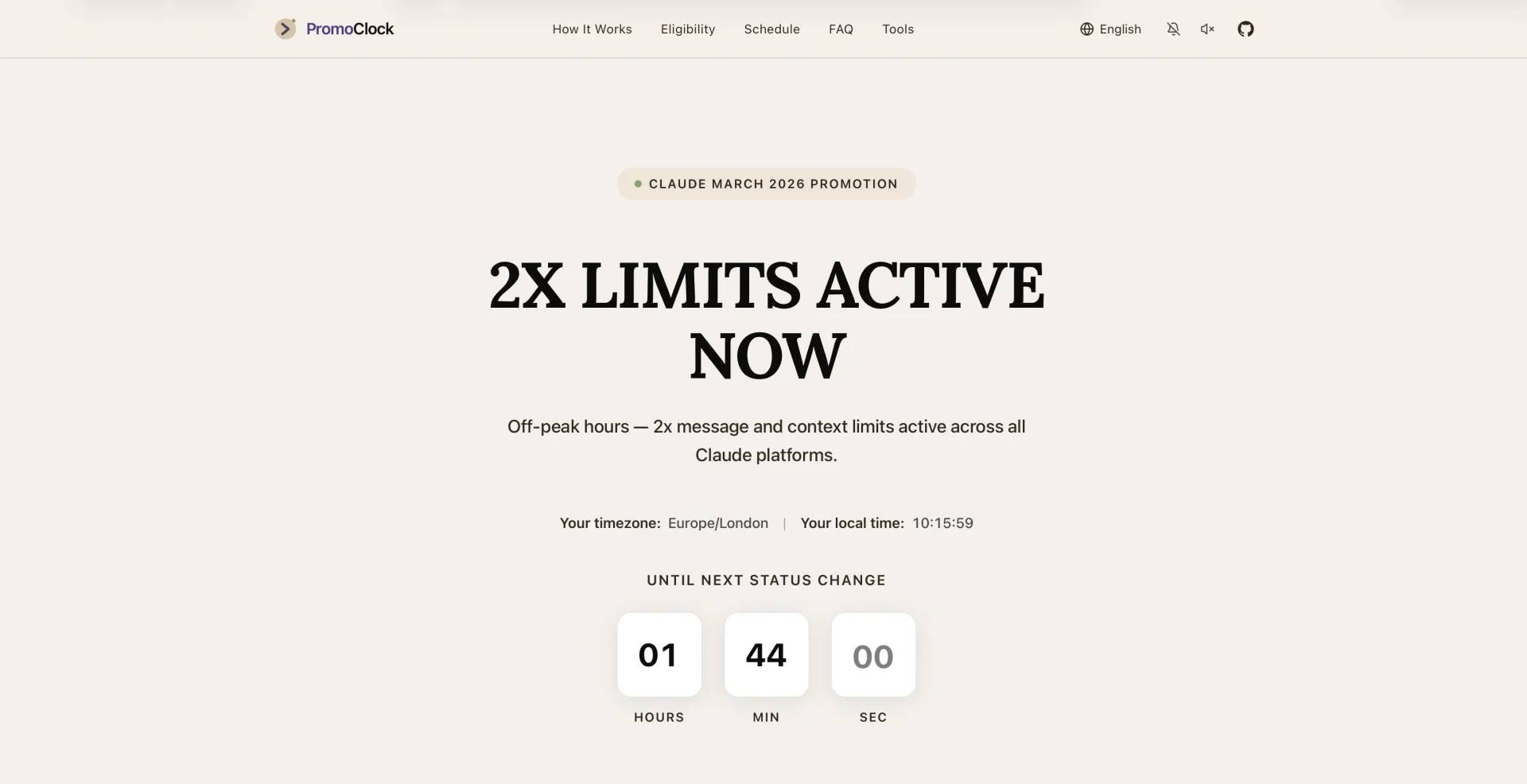
PromoClock answers one question instantly: is Claude's 2X usage boost active in your timezone right now? No client brief, no budget — just a real problem thousands of developers had, solved and shipped in a single weekend.

90+

countries reached in week one

10

languages, auto-detected

1

weekend to build and ship

<1s

load time, anywhere in the world

PromoClock — A weekend build that reached developers in 90+ countries.

If the website is down or looks different than the screenshot above, that's because the client has updated their website.

— DELIVERY & EVIDENCE

What changed.
What we can substantiate.

Starting point

Developers outside the US were manually converting a promotion’s Eastern Time schedule into their own timezone. This was a new public utility, with no previous product baseline.

Delivered scope

  • Timezone-aware status and countdown
  • Ten-language interface
  • Developer API and terminal integration
  • Calendar sync and optional notifications

Project duration: One weekend, as recorded in the project write-up.

TECHNICAL OUTCOME

Delivered capability & available evidence

A browser-based utility with ten languages, timezone detection and developer integrations. No dated, reproducible performance report is attached; a universal load-time claim would overstate the evidence.

Source: Digiwings project implementation and existing write-up

COMMERCIAL CONTEXT

Self-reported audience outcome

The project write-up reports visitors from 90+ countries in its first week. This is audience reach for a free tool; it does not establish qualified leads, sales or revenue.

Observation window: First week after the March 2026 launch

Source: Digiwings project write-up; a dated analytics export is not attached

First 30 days
No dated commercial comparison available for publication.
First 90 days
No dated commercial comparison available for publication.

— The story

How it came together.
Start to finish.

01

The challenge

Every developer using Claude knows the frustration. Anthropic announced a promotion that doubles usage limits during off-peak hours — but the peak window is defined in US Eastern Time: 8 AM to 2 PM ET on weekdays. For anyone outside the United States, the immediate question is always the same: “What time is that for me?”

Twitter was full of developers doing timezone calculations by hand — converting ET to GMT, JST, IST, BRT and every other timezone, then trying to remember which way the clocks had moved for daylight saving. It was a solvable problem, and nobody had built a proper solution for it.

We decided not to just use the promotion and move on. We wanted to solve the problem properly — and ship it fast enough that people could actually use it while the promotion was still running.

02

What we built

PromoClock is a single-page web application built around one job: the moment you open it, a clear green or red indicator shows whether 2X limits are active, with a live countdown to the next change and a visual timeline of peak and off-peak windows mapped to your local time.

It auto-detects your device timezone through the browser's Intl API — no manual selection, no IP geolocation, no permissions — and loads in one of 10 languages (English, Hindi, Japanese, French, Portuguese, Korean, Spanish, German, Chinese and Turkish) based on your browser preference.

Then we kept going, because developers don't just want a status page — they want tools they can wire into their workflow:

  • JSON API — a public /api/status endpoint returning real-time status as structured JSON (status, multiplier, time of next change, minutes remaining), ready to pipe into automations, dashboards and scripts.
  • Terminal integration — copy-paste ZSH and Bash snippets that show the live 🟢 2X / 🔴 1X status right in your prompt. No dependencies, just curl and python3.
  • Calendar sync — a downloadable .ics with every peak and off-peak window and VALARM reminders, for Google Calendar, Apple Calendar and Outlook.
  • Push notifications + sound alerts — enable the bell and get a browser notification with a gentle chime the instant the status changes, even with the tab in the background.
03

The technical decisions

We made a deliberate architectural choice: the entire 2X-detection logic runs client-side. No backend server, no database, no authentication. The app is a static site on a CDN — so it scales to any number of concurrent users with zero infrastructure cost, and response time depends on the nearest edge node, not a server.

The stack: React 19 with the React Compiler for automatic memoisation, Vite 8 for the build, and TypeScript throughout. The codebase is compact enough that the whole app — all 10 translations included — ships in a single bundle that loads in under a second on any connection.

04

The result

PromoClock launched the same day Anthropic's March 2026 promotion went live. Within its first week it reached developers in over 90 countries, was featured in a detailed technical write-up on DEV Community, and was shared across X, LinkedIn and developer forums — with developers wiring the API into their own terminals and automations.

It's the clearest way we know to show what we can build: do it in public, for a real audience, solving a real problem. PromoClock reached more people in a week than most agency portfolio pieces ever will.

— Scope

The build.
What it runs on.

Built with

  • React 19
  • React Compiler
  • Vite 8
  • TypeScript
  • Intl API
  • Web Push API
  • Notification API
  • Web Audio API
  • ICS generation
  • Cloudflare CDN

— FAQ

Frequently Asked Questions

Straight answers about this project.

Want results like this?

Every project starts with a straightforward conversation about what you actually need — no jargon or pressure. Tell us where you are now, and we'll explain what we would prioritise.

A clear recommendation, with no obligation to proceed.